Spanish spelling is almost perfectly regular — every letter says what it is supposed to, which is why reading it starts to feel reassuringly easy after a few weeks. Then a Colombian friend asks “¿Para dónde vas?” and it arrives as a single melted “pa-DON-de-vas,” the words run clean into one another, and the confidence evaporates. Spanish is spoken fast and joined-up, and the tidy version on the page is not the version that hits your ears.
That ear is exactly what YouTube is good for training — it holds more real Spanish than you could watch in a lifetime, from Mexican travel vloggers to teachers who slow every word down. But letting it play in the background won’t build the skill on its own. What does is comprehensible input aimed squarely at listening: material you can actually follow, climbing from beginner-slow up to native pace — the same loop behind learning any language from YouTube.
This is that method, plus the specific channels worth your time at each level. Every channel here is real and named so you can go press play the moment you finish reading. For a closer look at what 16 of them publish and who each suits, see the best YouTube channels for learning Spanish.
Why Spanish is hard to catch by ear (even when you can read it)
Most people who “know some Spanish” learned it with their eyes — flashcards, Duolingo, a textbook. Then they hear it and it dissolves into one long sound. That’s not you being slow; it’s a specific feature of spoken Spanish.
Spanish is a syllable-timed language spoken fast, with words that run straight into each other. Written out, ¿Qué vas a hacer? (“What are you going to do?”) is four tidy words. Said at normal speed it comes out closer to “keh-va-sa-SER” — the h is silent, the vowels fuse across word boundaries, and four words collapse into what sounds like two. This fusing (synalepha, if you like the technical name) is everywhere, and it’s why a sentence you’d understand instantly on paper vanishes when spoken.
On top of that, Spanish isn’t one accent. The c/z in Spain is a soft “th” (gracias → “grath-yas”) but an “s” across Latin America. Argentines turn ll and y into a “sh” (yo → “sho”). Caribbean Spanish drops the final s (más o menos → “má o meno”). None of this is a problem — it’s the reason Spanish is fun — but it means your ears need real, varied input, not one narrator reading slowly.
The fix for all of it is the same: hear a lot of real Spanish while you can see an accurate transcript, so your eyes teach your ears where one word ends and the next begins. That’s the whole game.
The method: climb the ladder, don’t jump it
The mistake is treating “watch Spanish YouTube” as one activity. It’s really three stages, and you graduate through them.
- Made-for-learners comprehensible input — a teacher speaking slowly, using gestures and drawings so you understand now, at 70–80% without translation. This is where acquisition actually starts. (More on the idea in comprehensible input, explained.)
- Semi-real content — street interviews and story channels: real accents and real speed, but with dual subtitles and a topic you can follow.
- Native content made for natives — the vloggers and comedians you’ll still be watching when you’re fluent. Above your level today; the goal is to pull them into reach now instead of waiting a year.
Aim for 70–80% understanding at whatever stage you’re in. Below that it’s noise; above it you’re not learning. When a level starts to feel easy, climb.
Stage 1 — Beginner: channels built to be understood
These creators speak slowly and visually so you follow along from day one. Start here even if you “did some Spanish in school.”
- Dreaming Spanish — the reference point for the whole comprehensible-input method (Spain). Hundreds of hours graded from Superbeginner upward; Pablo and the team use drawings, gestures and objects so you understand with zero English. If you watch one channel, watch this one.
- Butterfly Spanish — Ana teaches from Mexico with a warm, clear style that explains grammar and vocabulary without drowning you. Great for the “why does Spanish do that?” questions.
- Spanish After Hours — relaxed, fun lessons in Mexican Spanish that bridge you from single words toward following a real conversation.
Stay here until slow, clear Spanish feels comfortable — usually when you can watch a Dreaming Spanish Beginner video and follow the story without pausing every line.
Stage 2 — Intermediate: real accents, real speed, still followable
Now you want real people, but with enough support that you’re not lost. This stage is where most learners stall, because they either stay on beginner content forever or leap straight to native vloggers and bounce. These channels are the bridge.
- Easy Spanish — unscripted street interviews with dual Spanish/English subtitles. Real accents, real filler words, real speed — but short and captioned, so it’s the perfect first taste of “actual people talking.”
- Why Not Spanish — María interviews people across Latin America in a clear Colombian accent. Excellent for getting your ear used to more than one dialect.
- Español con Juan — Juan Fernández (from Granada, based in the UK) tells stories and explains grammar entirely in Spanish, repeating and circling ideas so your listening stamina grows. Ideal training wheels for “Spanish explained in Spanish.”
The goal at this stage isn’t to understand every word — it’s to follow the gist and let the unknowns wash past. When you can do that comfortably, you’re ready for the real thing.
Stage 3 — Advanced: native content made for natives
This is the material you’ll actually keep watching for life. It’s above your level today — and that’s fine, because with the right support (below) you can study it now rather than waiting until you’re “ready.”
- Luisito Comunica — one of the most-watched Spanish-language creators anywhere: travel and culture vlogs in everyday Mexican Spanish, clearly narrated and genuinely interesting.
- Linguriosa — Elena dives into the history and curiosities of the Spanish language itself, in clear Spain Spanish. You practise listening and learn why the language works the way it does.
- HolaSoyGerman — Germán, from Chile, is famous for talking at machine-gun speed in comedic rants. If you can follow him, you can follow anyone; it’s the ultimate speed test.
Pick a creator whose topic you’d watch in English anyway. Motivation beats “correct” material every time — the best video is the one you’ll actually finish.
Making the hard stuff comprehensible (the part most people skip)
Here’s the leap between “Spanish is on YouTube” and “I’m learning from it.” The native content in Stage 3 is exactly what you most want to watch — and exactly what’s a bit too fast to catch. The instinct is to avoid it until you’re better. That’s leaving your best, most motivating input on the table.
The fix is support: watch a native video with an accurate transcript running beside it, so your eyes catch the words your ears miss and finally connect that blurry “keh-va-sa-SER” to ¿Qué vas a hacer? Add an instant translation for the words you don’t know, and a video that was at your i+15 is suddenly running much closer to your i+1.
The catch with Spanish specifically is that YouTube’s auto-captions are unreliable exactly where you need them — fast speech, background music, regional accents and slang are where they garble words or go missing entirely, and Spanish content is full of all four. Caption-based tools inherit that problem, because they read the caption track the video already has. (We cover the whole category honestly in the best tools for learning a language from YouTube, and where caption-first tools run out of road in our Language Reactor alternative piece.)
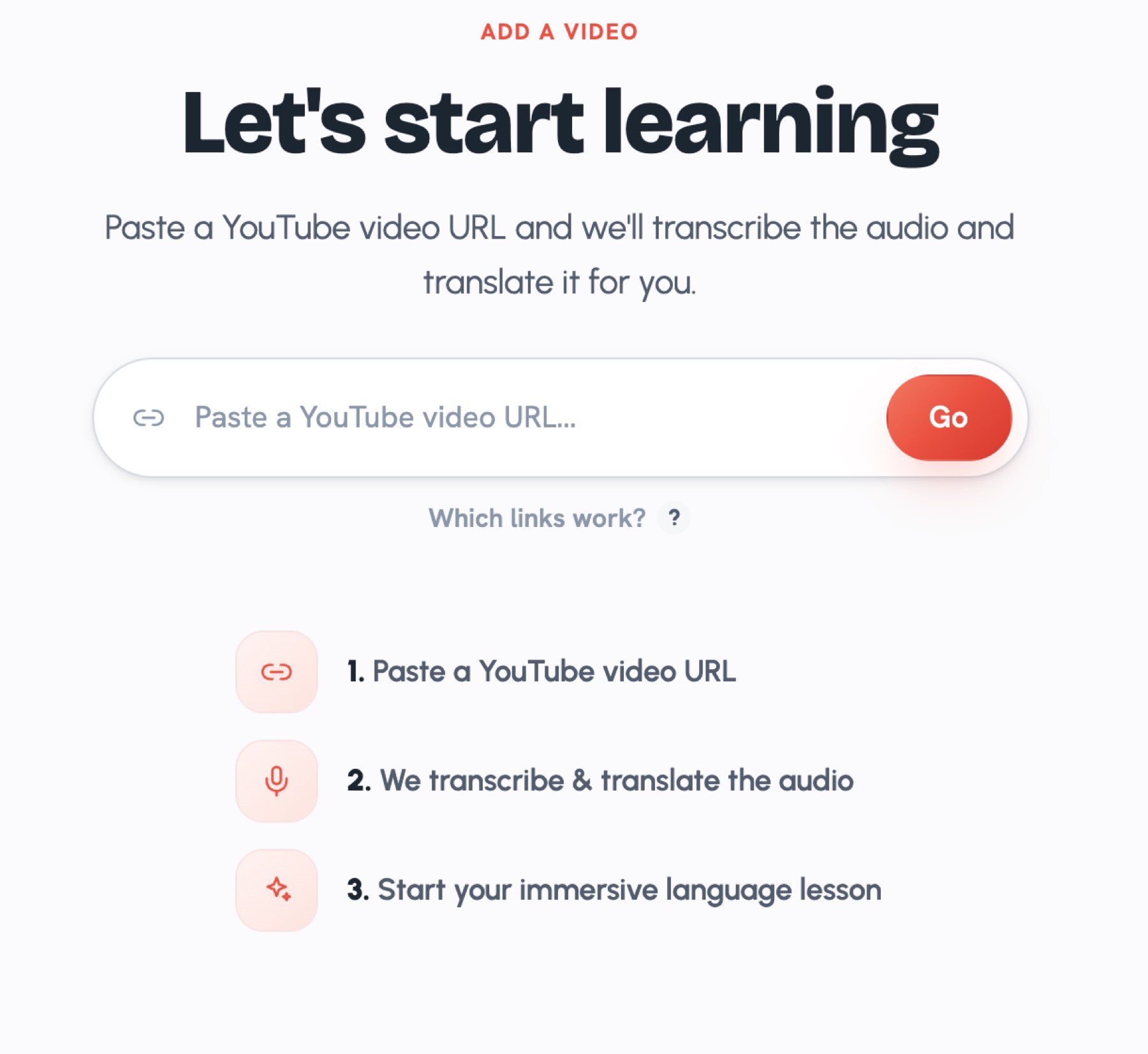
This is the gap we built Parlune to close. Paste any Spanish YouTube link and it transcribes the audio itself — not the caption track — and lines up a clean, accurate transcript with what’s actually said, even when the video has no captions or the auto-captions are garbage. Tap any word and it’s saved with its full sentence and the exact native clip it came from. Then the review games play that clip back and ask you to catch it by ear — which is the skill that reading a flashcard never builds. If your wall is “I can read Spanish fine but can’t hear it fast,” that’s precisely the case audio-first study is for (and the one we dig into in training your listening).
A simple weekly routine
You don’t need hours. Fifteen honest minutes of Spanish you understand beats an hour of noise.
- Pick one channel at your level from above and one native creator you’d genuinely watch for fun.
- Watch actively — read along with an accurate transcript, and when a word blocks the meaning, look it up and save it with its sentence and audio, not onto a bare list. (That’s sentence mining, and it takes seconds when the tool does the capture.)
- Review by ear a few days later — hear the clip, recall the meaning. This is what turns “I understood it once” into “I know it.”
- Climb when your level feels easy. Consistency over intensity, every time.
That loop — pick real Spanish, make it comprehensible, mine words in context, review by ear — is the entire method, and it’s the same one we lay out for any language in how to learn a language with YouTube the right way.
Start today
Spanish rewards this approach more than almost any language, because there’s so much real, varied, genuinely fun content to climb through — from Pablo drawing stick figures on Dreaming Spanish to Germán ranting at triple speed. You just need to meet it at the right level and give your ears the support to keep up.
Pick one channel from your stage and press play now. And when you hit a native video that’s almost within reach — the one your current setup turns to mush — see how Parlune works: paste it, get an accurate transcript of the real audio, and study the words by ear. Plans from $14.99/month. The Spanish you actually want to understand is already on YouTube; this is how you finally catch it.