You’ve finished the beginner app. You can introduce yourself, order a coffee, and conjugate a handful of verbs. Then you open a real YouTube video in your target language — and it all collapses into one fast, unbroken stream of sound.
This is the intermediate plateau, and almost everyone hits it. The advice you’ll hear is always the same: get comprehensible input — watch and listen to real native content you can mostly understand. It’s good advice. The problem is that raw YouTube, with no support, is exhausting. You pause every five seconds, look up words, lose the thread, and quit.
The good news: YouTube is arguably the best free language-learning resource ever made — millions of hours of real speech, on every topic, by real speakers, in dozens of languages. The trick is having a method so it works with your brain instead of against it. Here’s how to do it the right way.
1. Pick content you’d actually watch
The single biggest predictor of whether you’ll keep going is whether you enjoy the material. Motivation beats optimisation: a video you can’t wait to watch will teach you more over a month than a “perfect” lesson you dread. So forget “learner” content and pick from your real interests:
- A vlogger whose life you find interesting
- A podcast on a topic you already follow in your own language
- News, cooking, gaming, football — whatever you’d watch anyway
Aim for content where you understand maybe 70–80% already. Too easy is boring; too hard is noise. A useful rule of thumb: if you can follow the gist without subtitles but miss the details, that video is in your sweet spot. As you improve, the same channel will feel easier — that’s your progress made visible.
One more filter: prefer people talking naturally over heavily edited, music-over-everything content. Your goal is to train your ear on real speech, and a two-person conversation or a talking-head vlog gives you far more of it per minute than a fast-cut montage.
2. Read along with an aligned transcript
The trick that makes native video tractable is reading the words while you hear them. A transcript that’s aligned to the audio — so each line lights up exactly when it’s spoken — lets your brain connect the sound to the meaning instead of drowning. This is the difference between “listening practice” that frustrates you and listening practice that actually builds comprehension.
There’s a catch, though, and it’s the thing most tools get wrong: the transcript has to be accurate. YouTube’s own auto-captions are notoriously unreliable — they mangle proper names, miss technical words, and drop out entirely under background music or with strong accents. On smaller creator channels, they’re often missing altogether. Reading along with a wrong transcript teaches you the wrong thing.
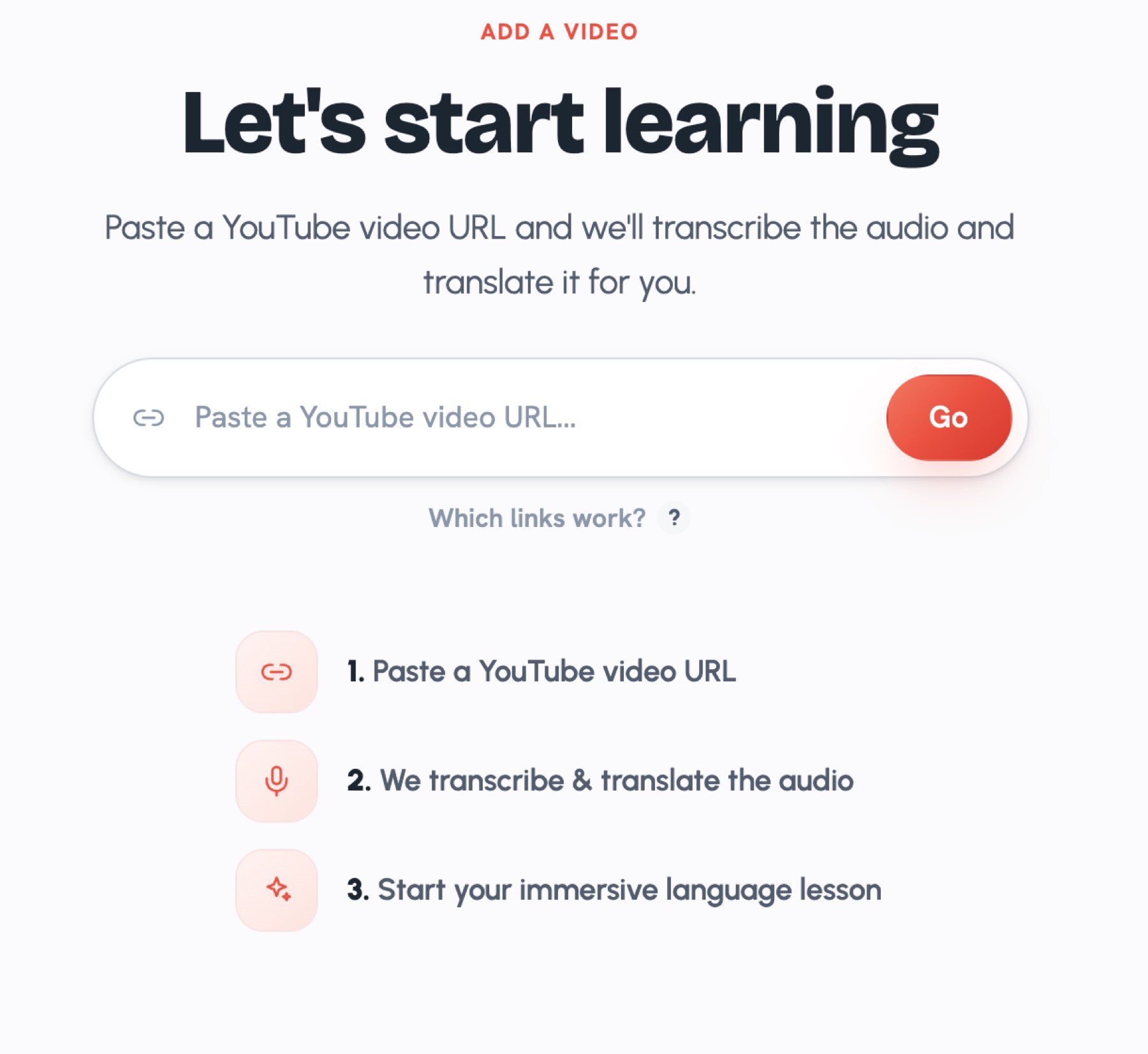
This is exactly what LingoReel does automatically: paste a link and it transcribes and translates any video into clean, audio-synced sentences — built from the audio itself, so it’s accurate even when the video has no captions or the auto-captions are wrong.
If you’d rather layer captions over the YouTube player instead, browser tools take a different approach — we compare that model in our Language Reactor alternative breakdown, and weigh the whole field in the best tools to learn a language from YouTube. The right choice depends on whether the captions you’d be reading are trustworthy in the first place.
3. Mine words in context — don’t make lists
When you meet a word you don’t know, don’t dump it on a naked vocabulary list. Capture it with the sentence it came from and, ideally, the audio of that exact moment. Words live in context — in phrases, in voices, in situations. A word saved with its sentence is a word you’ll actually remember, because you’re storing the meaning in use, not a dictionary gloss you’ll blank on the moment you hear it spoken quickly.
This practice has a name — sentence mining — and it’s one of the most effective things an intermediate learner can do. The classic version involves building flashcards by hand, which is slow enough that most people quit. The modern version is one tap: save the word, and it keeps its sentence and its audio automatically. Aim for quality over quantity — a handful of genuinely useful words per video, the ones that kept coming up or that you really wanted to understand, beats fifty you’ll never revisit.
4. Review with spaced repetition — and with audio
Seeing a word once isn’t learning it. Spaced repetition — reviewing each word right before you’d forget it — is the most evidence-backed way to move vocabulary into long-term memory. It’s the engine that turns “I’ve seen that word” into “I know that word.”
But here’s the gap most flashcard apps leave open: they only test the written word. If your goal is to understand speech, reading a word off a card doesn’t build the skill you actually want. You can end up “knowing” hundreds of words on paper and still missing every one of them when a native speaker says them at full speed.
The fix is to review with the sound. Games that replay the real native clip — asking you to catch the word, take dictation, or order the sentence by ear — train comprehension directly. That’s the half of the work text-only review quietly skips, and it’s exactly why so many learners can read far above the level they can understand out loud. Closing that gap is the whole point of studying from video in the first place; for more on why fast speech is so hard and how to train for it specifically, see our guide to understanding fast native speech.
5. Make it a daily habit, not a marathon
Fifteen focused minutes a day beats a three-hour session once a week. Language acquisition rewards consistency — little and often — because memory is built by repeated, spaced exposure, not by cramming. Keep the loop tight:
- Watch a few minutes of something you enjoy
- Tap the words you don’t know to save them
- Play a quick review of what you’ve saved
That’s the whole method: watch, tap, play. Your watchlist becomes your syllabus, and the content you already love does the heavy lifting. Do it daily and the plateau you’re standing on now becomes the floor you’re standing above a few months from now — the same channels get easier, the blur resolves into words, and you start reaching for harder content because the old stuff feels slow.
The short version
- Watch what you’d watch anyway — enjoyment is the real learning hack.
- Read along with an accurate, audio-aligned transcript — not whatever caption track happens to exist.
- Mine words with their sentence and audio, not on a bare list.
- Review by ear, not just by sight, so you train comprehension.
- Fifteen minutes a day, every day, beats the occasional marathon.
LingoReel was built to make this loop frictionless — any YouTube video, an accurate audio-built transcript, instant tap-to-save, and review games on the real native audio. Start learning from your own videos — plans from $14.99/month, cancel anytime.