Take the word for “milk”: молоко. It has three о’s, and a native speaker pronounces exactly one of them as an “o” — the two unstressed ones soften to a vague “a,” so the whole word lands as “muh-la-KO.” Nothing on the page tells you which syllable takes the stress or that the other vowels change colour; Russian simply doesn’t mark it. Multiply that across every sentence and you get the real Russian wall: the tidy Cyrillic you learn to read and the fast, reduced stream you actually hear are almost two different languages, and the second one is an ear skill textbooks barely touch.
YouTube is the best place there is to build that ear — it holds more real Russian than you could get through in years, from teachers drawing on a whiteboard to two-hour interview shows with millions of native viewers. But hours of it playing in the background won’t rewire your listening on their own. What does is comprehensible input aimed at your ear — material you can follow now, worked upward from beginner-slow to native pace. That’s the same method we lay out for learning any language from YouTube; this piece is the Russian-specific version of it, with the exact channels to press play on at each stage. Every one is named and verified so you can go straight from here to watching.
Three things make spoken Russian slip past your ear
Plenty of people “know some Russian” from an app or a class and then can’t follow a single sentence of the real thing. That isn’t a memory failure — it’s that reading Russian and hearing it draw on genuinely different skills, and three features of the spoken language open the gap.
1. Stress is unpredictable, unmarked, and it changes the vowels. Russian stress can fall on any syllable, it shifts as a word changes form, and ordinary text never shows you where it is. Worse, unstressed vowels reduce: an unstressed о is spoken like an “a” (this is called akanye). So хорошо (“good,” “well”) comes out “kha-ra-SHO,” and говори́т (“says”) sounds like “ga-va-RIT.” You can recognise these words instantly on paper and still miss them completely by ear, because the vowels you’re listening for aren’t the vowels being said.
2. Hard and soft consonants change meaning in ways English ears ignore. Almost every Russian consonant comes in a “hard” and a palatalized “soft” version, and the difference is not decoration — it’s meaning. брат (brat, “brother”) and брать (brat’, “to take”) differ only in whether that final т is soft. To an untrained English ear they sound identical; to a Russian they’re two different words. Your ear has to learn a contrast your native language throws away.
3. Words wear a different ending every time you meet them. Russian has six grammatical cases, so a single noun changes its tail — and often its stress — depending on its job in the sentence: стол (“table”) becomes стола́, столу́, столо́м, столе́. Verbs add their own layer with aspect (perfective vs imperfective) and the notorious verbs of motion. So even a word you “know,” your ear has to recognise under a shifting ending it’s never quite heard before.
On top of all that, spelling openly lies about sound: здравствуйте (“hello”) is said “ZDRA-stvuy-tye” with the в gone, что (“what”) is “shto,” and сего́дня (“today”) comes out “si-VOD-nya.” Take a plain line like Я не понима́ю, что ты говори́шь (“I don’t understand what you’re saying”) — on the page it’s five clean words; spoken quickly it’s a rush where что is “shto” and the reduced vowels blur the rest together.
The remedy for every one of these is the same, and it’s the reason a good transcript matters more for Russian than for most languages: hear a lot of real speech while your eyes track an accurate, tappable transcript, so you can finally see that “muh-la-KO” is молоко and pin the sound to the spelling. Passive watching alone won’t get you there — you need comprehensible input and a method, which is the whole argument of the two pillars linked above. What follows spends its words on the Russian-specific part.
Meet Russian at three altitudes, and move up when it gets easy
The trap is to treat “watch Russian YouTube” as one thing. It’s really three tiers of difficulty, and the skill is knowing which one you belong on today and when to step up.
- Made-for-learners input — a teacher speaking slowly and visually so you understand right now, roughly 70–80% without translation. This is where acquisition actually begins.
- Semi-real content — street interviews and slow story channels: genuine accents and speed, but short, subtitled, and on a topic you can hold onto.
- Native content made for natives — the interviewers, vloggers and podcasters you’ll still be watching when you’re fluent. Over your head today; the aim is to make short pieces of it usable now.
Wherever you are, hold yourself to 70–80% understanding. Much below that and it’s noise that doesn’t stick; well above it and you’ve stopped learning. When a tier starts to feel comfortable, move up a rung.
Tier 1 — Beginner: channels built to be understood
These creators slow down and lean on pictures, gestures and repetition so you follow from the first video. Start here even if you already read Cyrillic.
- Comprehensible Russian — Inna teaches entirely in Russian using a whiteboard, drawings and gestures, so you understand with no English at all, and her videos are graded from “Zero Beginners” up. Free PDF transcripts come with them. If you watch one channel to start, make it this one — it trains your ear on natural rhythm and reduction from day one.
- Be Fluent in Russian — Fedor explains the machinery in clear English: the cases, verb endings, aspect and the soft/hard distinction that trip every beginner. This is the “wait, why does Russian do that?” channel to reach for when a grammar point won’t click.
- Real Russian Club — Daria, a certified teacher from Moscow, runs a big library of clear vocabulary, grammar and pronunciation lessons, plus simple vlogs. Especially good for drilling the sounds — including which syllable actually takes the stress.
Stay here until slow, clear Russian feels easy — usually the point where you can follow one of Inna’s beginner videos without pausing every line.
Tier 2 — Intermediate: real voices, real speed, still followable
Now you want actual people, but with enough scaffolding that you can still keep up. This is the tier where progress most often stalls: learners either settle into graded lessons indefinitely or jump to a native talk show, understand nothing, and retreat. These three sit in between.
- Russian with Max — Max speaks slowly and enunciates cleanly while telling stories and talking about culture and travel, glossing hard words in Russian as he goes. Aimed squarely at A2–B1+, and his Comprehensible Russian Podcast gives you the same voice for listening on the move.
- Easy Russian — part of the Easy Languages project: unscripted street interviews from Moscow, St Petersburg and beyond, with dual Russian/English subtitles. Real filler words, real accents, real speed — but short and captioned, which makes it the softest possible landing into unscripted conversation.
- Russian Progress — Artyom takes you along on walks and trips, narrating in natural-but-clear Russian with subtitles. Longer and more real than a lesson, it’s ideal for building the listening stamina to sit with continuous speech.
The goal here isn’t every word — it’s holding the thread and letting the words you miss slide by without stopping. Once that feels comfortable, you’re ready for the deep end.
Tier 3 — Advanced: native content made for natives
This is the payoff: Russian made for Russians, at full speed, with the reduction, stress-shifts and slang all live. You won’t catch everything, and you’re not meant to. The move is to take short stretches and work them until you can.
- вДудь (vDud) — Yury Dud’s long-form interview show, one of the most-watched channels in Russia, with millions of native viewers. Guests range across music, film, sport and public life, the speech is completely natural, and the interview format keeps a clear thread you can hang on to while your ear does the heavy lifting.
- Редакция (Redaktsiya) — Alexey Pivovarov’s documentary-reporting channel. Studio narration alternates with field interviews, so you get clean, professionally-enunciated Russian and ordinary people speaking however they speak, inside the same twenty minutes. The narration is the easier half — use it as your handhold when an interview runs away from you.
- varlamov — Ilya Varlamov walks around cities in Russia and abroad explaining why they look the way they do. He talks steadily to camera about concrete, visible things, which means the picture is constantly telling you what the words mean — the single most forgiving format at native speed.
Beyond those, find the Russian equivalent of something you’d happily watch in English — a cooking channel, a gaming streamer, a sketch duo. Enjoyment is what buys you the hundreds of hours real fluency takes; the “right” video is the one you’ll actually finish.
The danger at this tier is passive watching. Native content only levels you up if you occasionally stop and decode a piece of it — which is exactly what the next section is for.
The part most people skip: turning a hard video into practice
Here’s where “Russian is on YouTube” becomes “I’m learning Russian from YouTube.” The native content in Tier 3 is the stuff you most want to watch and also the stuff that’s a shade too fast to catch. Avoiding it until you’re “better” leaves your most motivating input on the shelf.
The fix is support. Watch a native clip with an accurate transcript running beside it, so your eyes catch the words your ears smear together — and that reduced “kha-ra-SHO” finally resolves into хорошо on the page. Add an instant translation for the words you don’t know and a clip that was miles over your head drops to just above it.
The catch, specifically for Russian, is that YouTube’s auto-captions fall apart exactly where Russian is hardest: reduced vowels, unmarked stress and fast connected speech are precisely what they mis-hear, and a huge amount of Russian content has no captions at all or auto-captions in the wrong language entirely — a detection failure Google has said it won’t fix. Caption-based study tools inherit that problem wholesale, because they read whatever caption track the video already carries. (We go through the whole category honestly in the best tools for learning a language from YouTube, and where caption-first tools hit their ceiling in our Language Reactor alternative piece.)
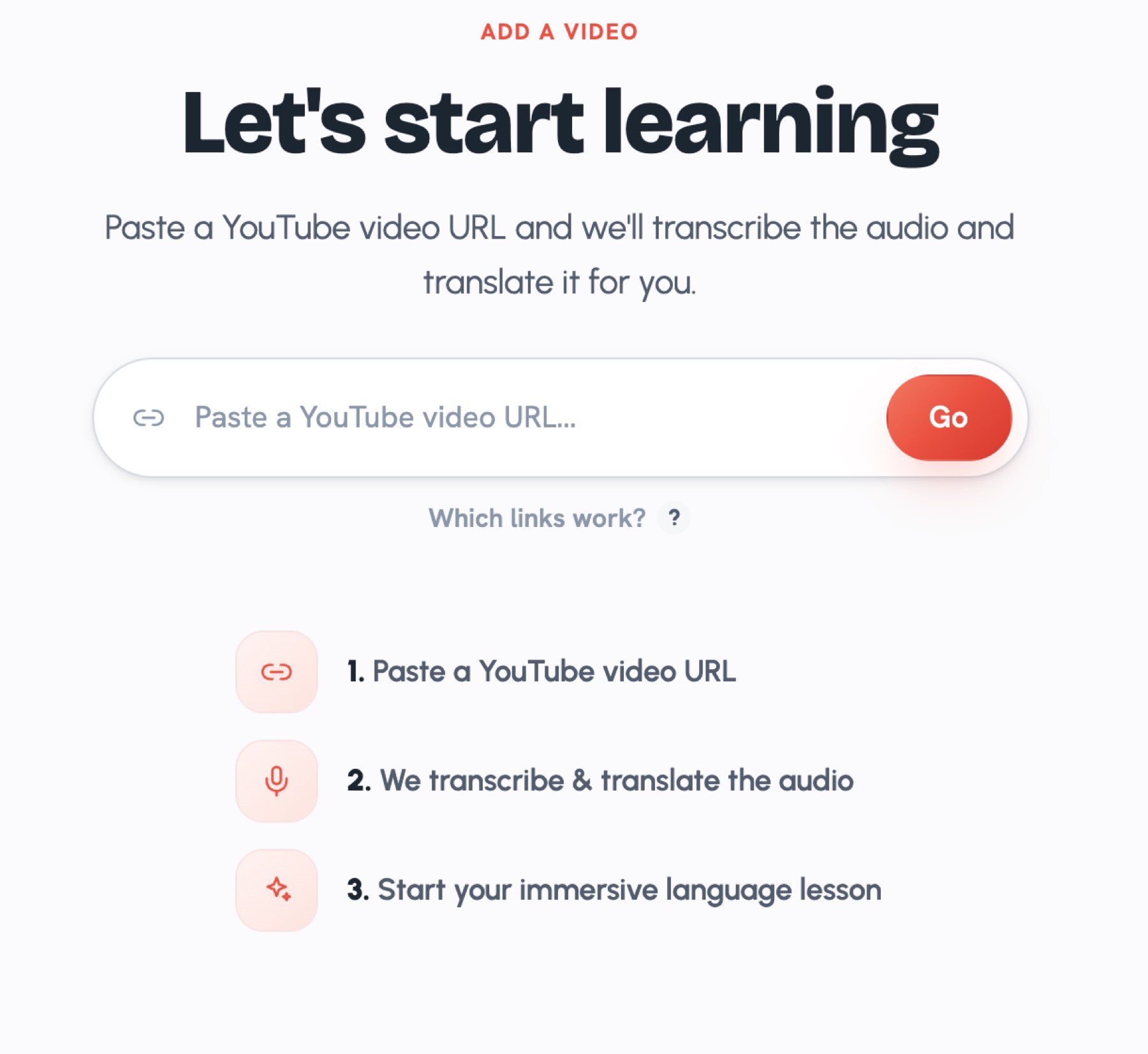
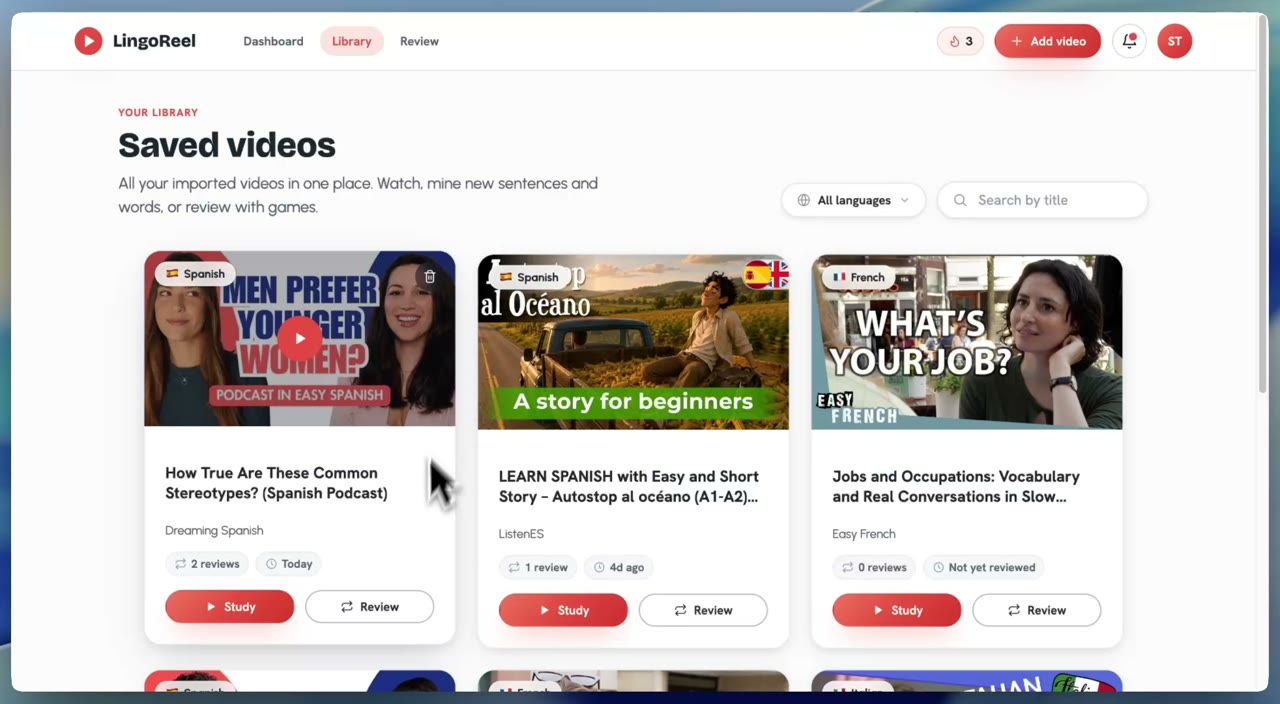
This is the exact gap Parlune was built to close. Paste any Russian YouTube link and it transcribes the audio itself — not the caption track — into a clean, accurate Cyrillic transcript lined up with what’s really said, even when the video has no captions or the auto-ones are garbage. Tap any word and it’s saved with its full sentence and the exact native clip it came from. Then review replays that clip and asks you to catch it by ear — the one skill a written flashcard can never build.
Review Russian by ear, not just by eye
What you do after you decode a clip matters as much as the decoding. Russian punishes eye-only review harder than most languages, because the two things that trip your listening — which syllable is stressed and how the unstressed vowels reduce — are completely invisible on the page. A word you can read off a card tells you nothing about whether молоко is “MO-lo-ko” or “muh-la-KO” (it’s the second). Save a new word as written text alone and you’ve dropped the hardest half of the job.
So when you mine sentences from a video, keep the audio of the exact moment, and review on that clip: catch the word by ear, take dictation, rebuild the sentence you heard. That’s how a word you decoded once becomes a word you’ll actually recognise the next time it flies past at speed — and it’s the heart of training your listening so fast Russian stops sounding like one long word.
A realistic weekly routine
You don’t need marathon sessions. Fifteen honest minutes of Russian you understand beats an hour of wallpaper.
- Daily (15–20 min): one video at your tier — Comprehensible Russian or Russian with Max — as relaxed, gist-level listening to build stamina.
- A few times a week (10 min): one short clip from a tier above yours, worked until you can hear every word — listen blind first, then reveal the transcript, then listen again now that you know what’s there.
- Weekly: mine three to five sentences you liked, with their audio, and review them by ear across the week — say each one back and put the stress where the speaker did.
That loop — pick real Russian, make it comprehensible, mine words in context, review by ear — is the whole method, and it’s the same one we set out for any language in how to learn a language with YouTube the right way.
Start today
Russian pays this approach back generously, because once your ear adjusts to the reduction and the stress-shifts, an enormous library of real, genuinely interesting content opens up — from Inna’s whiteboard stories to a two-hour Dud interview. You just have to meet it at the right tier and give your ears the transcript support to keep up.
Pick a tier, pick a channel, press play tonight. And keep one hard clip in reserve for Parlune — paste any Russian video and it transcribes the real audio, so the blur you heard as “kha-ra-SHO” resolves into хорошо on the page and the stress finally has somewhere to sit. Plans from $14.99/month, no ads. Once your ear stops hunting for vowels nobody said, an enormous library opens up.