Ask a Brazilian and a Lisboner to say não and you get two different sounds from the same three letters: an open, drawn-out “nowng” on one side of the Atlantic, and a clipped, nasal “nãu” on the other. That split runs through the whole language. Brazilian Portuguese lands almost every vowel full and open, with a sing-song rise and fall; European Portuguese crushes the unstressed ones flat, so Estás a ver? (“You see?”) arrives as a compressed “shtázh-a-vér” — the vowels gone, the s’s hissing like “sh.” Before Portuguese is a vocabulary problem, it’s this: you have to pick which Portuguese your ear is training on, because the two don’t sound alike.
YouTube is where you do that training. It holds more real Portuguese than you could watch in a decade — Brazilian science channels, Lisbon street interviews, comedy troupes, cooking shows, football rants — in both varieties, at every speed. But volume alone won’t retune your ear. Passive watching rarely does; what moves the needle is comprehensible input aimed at listening, followable now and climbing toward native pace, which is the same core loop behind learning any language from YouTube. This piece is the Portuguese-specific version: which variety to commit to, the sounds that trip up every learner, and the named channels worth pressing play on at each level.
First decision: which ocean — Brazil or Portugal?
This is the one choice Spanish or French learners never have to make, and it matters most for listening. The two standards share spelling and most vocabulary, so on the page they look like near-twins. Out loud they diverge hard, and if you train your ear on one while planning to use the other, real speech will keep ambushing you.
The differences aren’t just accent. Brazilian Portuguese is roughly vowel-timed and open: syllables get near-equal weight, unstressed vowels stay audible, and the melody is famously lilting. European Portuguese is stress-timed: the stressed syllable dominates and the unstressed vowels around it shrink or vanish, which is why it can sound faster and more consonant-heavy — learners often say it reminds them of a Slavic language on first listen. Even the grammar you’ll hear forks: “I’m doing it” is estou fazendo in Brazil (gerund) but estou a fazer in Portugal (infinitive); Brazilians mostly say você, the Portuguese say tu with its own verb endings; and pronouns land in different places (chamo-me in Lisbon versus me chamo in São Paulo).
You don’t have to marry one forever — plenty of learners end up comfortable with both. But for the first several months, pick the one you actually have a reason to use (family, travel, work, the music you love) and weight your input heavily toward it. Your ear needs a home base before it can enjoy the tour.
The sounds that go missing
Whichever side you choose, a handful of features make spoken Portuguese vanish on you in ways the spelling never warns about. Naming them is half the cure.
- Brazil turns d and t into “dj” and “tch.” Before an i sound, dia (“day”) is “DJEE-a,” tia (“aunt”) is “TCHEE-a,” gente (“people”) is “ZHEN-tchi,” and cidade (“city”) ends “-DA-dji.” This palatalization is everywhere in Brazilian speech and nowhere in the written word — so a beginner hunting for the crisp “t” and “d” they studied simply doesn’t hear them. Portugal keeps the hard consonants, so this one is Brazil’s alone.
- Portugal deletes the unstressed vowels. The clean e in pequeno (“small”) barely survives; whole syllables compress. Coda s becomes “sh” (os livros → “ush LEE-vrush”; estás → “shtásh”), which is why European Portuguese sounds hissier and tighter. Rio does the “sh” too; São Paulo keeps a plain “s.” The result: the word on the page has more in it than the sound does.
- The nasal diphthongs, especially -ão. Não, pão (“bread”), mãe (“mother”), coração (“heart”), and their plurals in -ões ride a nasal glide that English doesn’t have. The trap is a minimal pair like mau (“bad”) versus mão (“hand”) — near-identical to an untrained ear, oral diphthong against nasal one. You can only learn to split them by hearing them, a lot.
- Open versus closed vowels change the word. Avó (open ó, “grandmother”) and avô (closed ô, “grandfather”) differ only in vowel quality; so do pode (“can,” present) and pôde (“could,” past). Miss the distinction and you miss which relative — or which tense — someone means.
- Casual Brazilian shears words down. Você becomes “cê,” está becomes “tá,” estou becomes “tô,” para becomes “pra,” and não é? collapses to “né?” So the textbook Você está bem? is really spoken “Cê tá bem?” — three written words you’ll never fully hear.
Read that list and the pattern is clear: reading Portuguese teaches you almost nothing about catching it by ear. The gap between the two skills is wider here than the shared spelling lets on. (If you want the general case for why input beats passive watching, it’s laid out in the comprehensible input guide and the pillar on learning from YouTube — no need to re-argue it here.)
A three-rung climb, in your chosen variety
Treat “watch Portuguese YouTube” as three distinct rungs, not one activity, and label each channel below (BR) for Brazil or (PT) for Portugal so you can stay in your lane. The target on any rung is roughly 70–80% understood: too far below and your brain tunes out, too far above and nothing is stretching. When a rung stops costing effort, move up.
Rung one — made to be understood
Slow, clear, visual teaching where you follow along from the first video:
- Speaking Brazilian (BR) — Virginia Langhammer’s channel is the reliable Brazilian starting point: clear pronunciation drills, grammar untangled patiently, and videos sorted by level. Good specifically for training your ear onto the “dji/tchi” sounds early.
- Talk the Streets (PT) — Liz Sharma teaches the colloquial European Portuguese real people actually use in Lisbon, not the textbook register — the right foundation if Portugal is your target, because she front-loads the reductions instead of hiding them.
Rung two — real people, real speed, still followable
Now you want native voices with enough support that you’re not drowning:
- Portuguese With Leo (PT) — the biggest European Portuguese channel, and for good reason: Leo speaks carefully and clearly about culture, history and the language itself, and regularly interviews speakers from across Portugal and the islands so you hear more than one accent.
- Practice Portuguese (PT) — Rui (native) and Joel (learner) model both sides of the conversation, so you hear authentic Lisbon speech and someone finding their footing in it. Their shorter dialogues are ideal intermediate listening.
- Easy Brazilian Portuguese (BR) — part of the Easy Languages network: unscripted street interviews with Portuguese and English subtitles, plus slower “Super Easy” episodes. Real filler words, real speed, but short and captioned — the first honest taste of “actual people talking.”
Rung three — native content, made for natives
The stuff you’ll still be watching once you’re fluent. It’s over your head today — good; the trick is to borrow it early instead of postponing it until some imagined “ready”:
- Manual do Mundo (BR) — one of Brazil’s biggest channels (science, experiments, how-things-work), narrated with clear, enthusiastic energy. Genuinely interesting even in English, which is exactly what keeps you watching in Portuguese.
- Porta dos Fundos (BR) — the comedy sketch troupe that defined Brazilian YouTube. Fast, slangy, and unfiltered (adult humour) — if you can follow their punchlines, you’ve made it. A great speed-and-slang stress test.
- Wuant (PT) — one of Portugal’s most-watched creators: vlogs, commentary and reactions in fast, current youth slang. Rough going at first, but it’s the real, unslowed European Portuguese of people your own age.
Pick a rung-three creator whose topic you’d click on in your own language. Interest is what buys you the hours; a “correct” video you quit halfway teaches less than a silly one you watch twice.
The drill: find what the sound dropped
Because Portuguese hides so much inside the audio — Brazil’s fused “cê tá pra,” Portugal’s deleted vowels — the single most useful exercise is to make the disappearances visible. It takes a few minutes per clip:
- Play a short line — ten to twenty seconds — with no text, and write down what you hear, syllable by syllable, best guess. Count the beats.
- Reveal the accurate transcript and compare. Mark every place the sound had less in it than the writing: an EP vowel that got swallowed, a Brazilian de/te that went “dji/tchi,” a você está that shrank to “cê tá,” an -ão you’d heard as a plain vowel.
- Listen once more, reading along, and feel the mismatch resolve — the written form snapping onto the compressed sound you actually hear.
That third listen, once your eyes have shown your ears what was really there, is the rep that sticks. There’s a fuller version of this in the guide to training your listening so native speech stops sounding like one long word.
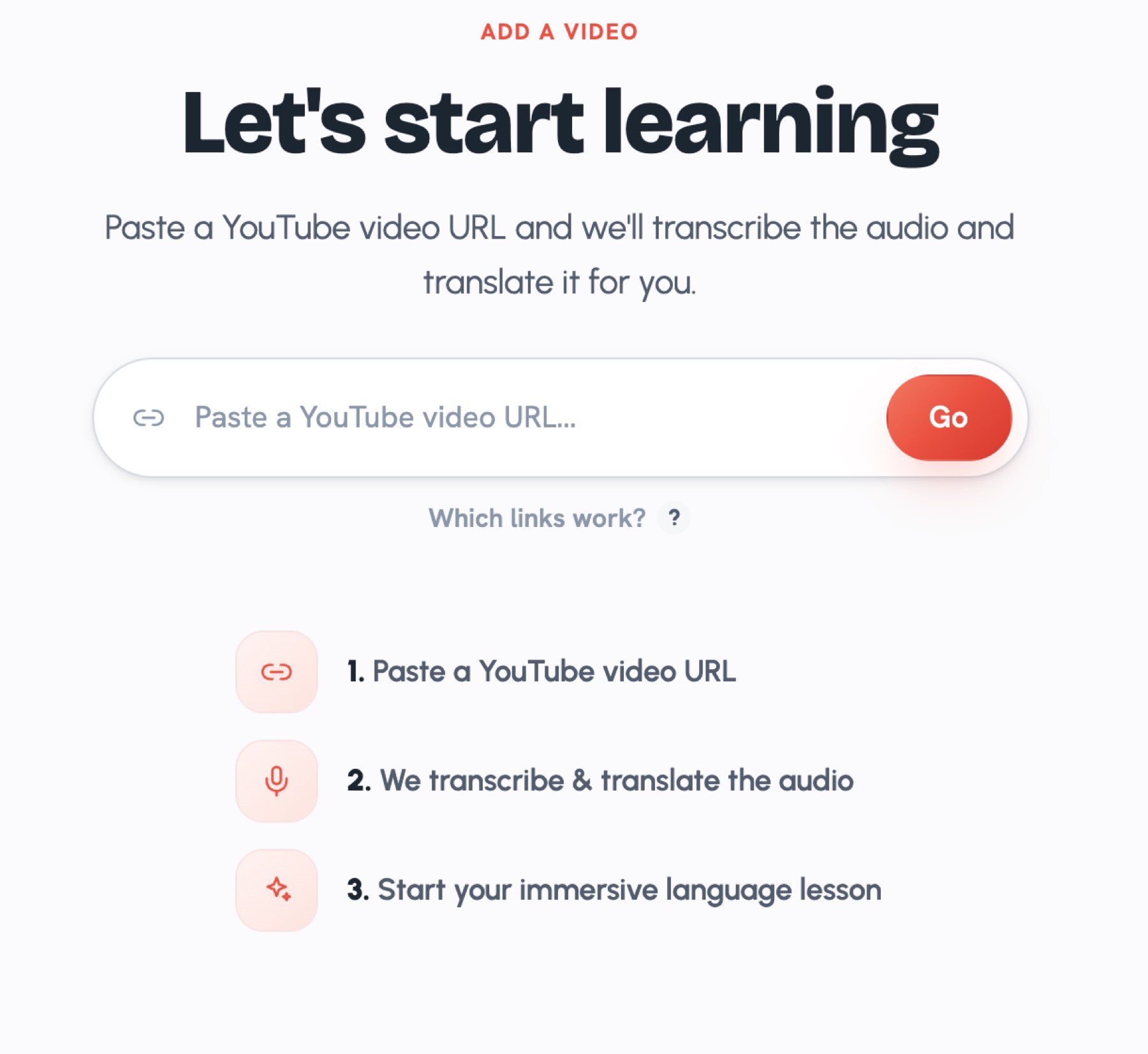
The catch has always been getting an accurate transcript. Most Portuguese videos have no captions, or auto-captions that mangle exactly the hard parts — the reduced EP vowels, the nasal diphthongs, fast Brazilian slang — and when a caption is on screen it sits there the whole time, so you can never listen blind first. This is the gap Parlune was built to close: paste any Portuguese YouTube link and it transcribes the audio itself — not the video’s caption track — into clean, audio-aligned sentences you can tap word by word, accurate even when the video has none. Listen to a line cold, then uncover the exact words behind it. (We cover the whole category honestly in the best tools for learning a language from YouTube, and where caption-first tools run out of road in the Language Reactor alternative piece.)
Keep the sound, not just the spelling
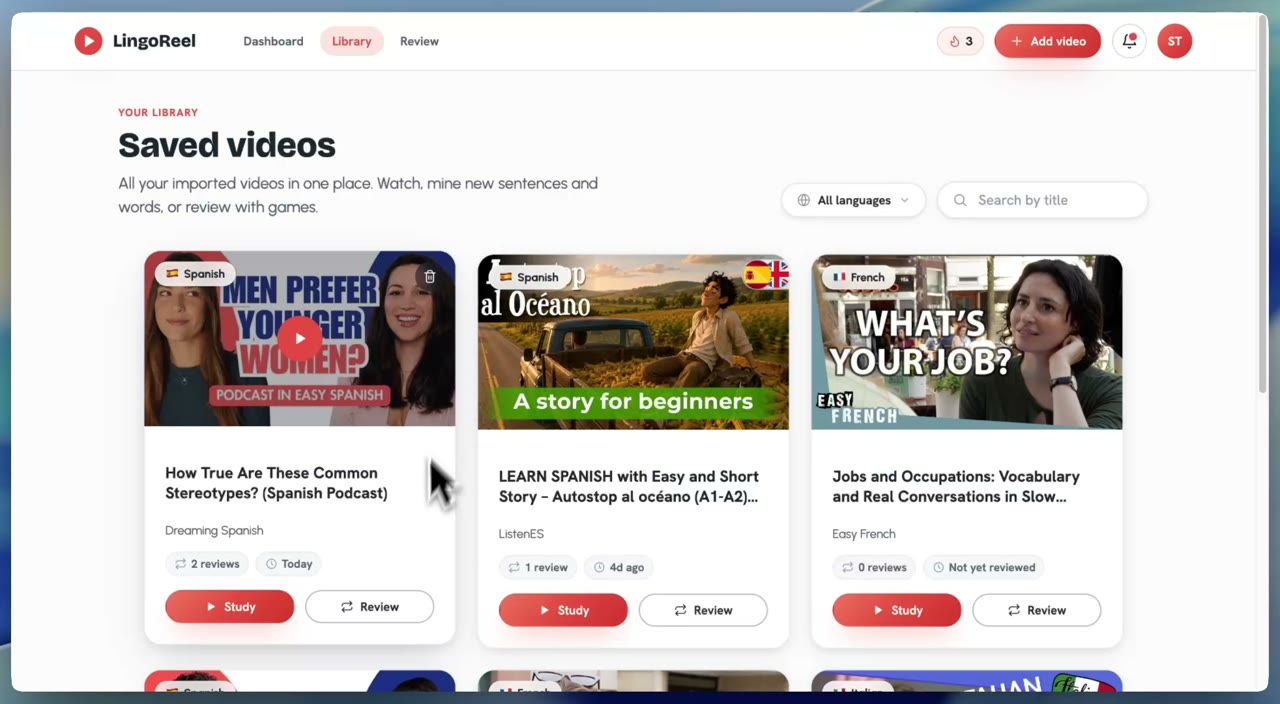
What you do after decoding a clip decides whether it sticks. If you save a new word to a card that only shows the written form, you’ve kept the easy half and thrown away the hard one — because in Portuguese the written form tells you nothing about whether that d was a “dji,” whether the vowel was open or closed, or how the whole phrase compressed at speed. So when you mine a sentence from a video, keep the audio of the exact moment and review on that — catch it by ear, take dictation, rebuild what you heard. That’s the difference between recognising a word on a page and understanding it when it flies past.
A routine that fits a normal week
- Most days (15 min): one clear rung-one or rung-two video in your chosen variety, watched actively with an accurate transcript — gist-level, building stamina.
- A few times a week (10 min): one short clip from a rung above, run through the find-what-dropped drill until you can hear every syllable.
- Weekly: mine three to five sentences you liked, with their audio, and review them by ear across the week — keeping them all in one variety so your ear isn’t switching oceans.
Fifteen honest minutes of Portuguese you actually understand beats an hour of background sound. Consistency wins.
Where to start
Portuguese pays this method back generously, because the content is so rich and so varied — a Lisbon linguist, a Brazilian science channel, a comedy sketch, a street interview — and because its two varieties give your ear more to enjoy, not just more to learn. The one non-negotiable is meeting it at the right level with the support to keep up.
So decide — Brazil or Portugal — pick one channel from your rung, and press play today. And the next time a native video dissolves into “cê tá” and swallowed vowels, hand it to Parlune: paste the link, get a transcript of what’s really being said, and drill the phrases by ear until they stop slipping past. Subscription plans from $14.99/month, no ads. Whichever ocean you picked, the sound is learnable once you can see what went missing.