You can learn to read Hangul in an afternoon — it really is that logical — and for the first week or two Korean feels like pronunciation is a solved problem. Then a friend says 좋아요 and the ㅎ has quietly vanished: it lands as 조아요, “jo-a-yo,” two smooth syllables with no trace of the letter sitting right there in the spelling. Say 맛있어요 (“it’s delicious”) at normal speed and it melts into 마시써요 — the final consonant of one block slides onto the next before you can catch it. Korean is spelled one way and spoken another, and the distance between those two is exactly where listening falls apart.
There is no shortage of Korean to pour into that gap. YouTube holds more of it than you could watch in a decade — teachers enunciating every 받침, street interviews, variety shows firing at full speed. But hours of it running in the background won’t rewire your ear; passive watching alone never does. What works is comprehensible input pointed straight at listening — material you can follow now, stepped up toward native speed — the same loop behind learning any language from YouTube.
This is that method, built around how Korean actually sounds, with the specific channels worth your time at each level. Every channel here is real and named, so you can press play the moment you finish reading.
The sound-change rules Hangul doesn’t show you
Almost everyone reaches spoken Korean through the page first — an app, a textbook, a week of Hangul drills. The script is so clean, and so quick to pick up, that the written word and the spoken word feel like they ought to be the same thing. They aren’t. Korean runs on a dense set of pronunciation rules that quietly rewrite consonants at every syllable boundary, and not one of them shows up in the spelling. Three do most of the damage to a listener.
1. Final consonants don’t stay put. A 받침 (batchim — the consonant at the bottom of a syllable block) constantly jumps, blends, or drops when it meets the next sound. It slides forward onto a following vowel: 맛있어요 is written mat-iss-eo-yo but said 마시써요, ma-si-sseo-yo. It disappears: 좋아요 → 조아요. It changes identity to match its neighbour: 국물 (“broth”), spelled guk-mul, is spoken 궁물, gung-mul — the ㄱ turns into an ㅇ because an ㅁ follows it. So the word you carefully memorised from a flashcard is not the sound that reaches your ear, and no amount of reading practice closes that gap.
2. The most important word lands last. Korean is verb-final: the verb, its tense, whether it’s negative, and how polite it is all arrive at the very end of the sentence. 저는 어제 그 영화를 안 봤어요 — the “didn’t watch” is the last thing said. You can’t confirm what someone means until they finish, which is a different listening muscle than English’s front-loaded “I didn’t…”. You have to hold the whole sentence open and resolve it at the end.
3. Real speech isn’t textbook speech. Textbooks teach 존댓말 — the polite -요 and formal -습니다 endings. Friends speak 반말, and they clip it: 밥 먹었어? (“d’you eat?”) is what you’ll actually hear, not the textbook 식사하셨어요? On top of that, spoken Korean drops the very particles (은/는, 이/가, 을/를) that a beginner leans on to find where one word ends and the next begins. Take those away and a sentence you’d parse easily on paper becomes a smooth, particle-less blur.
The fix for all three is the same, and it isn’t more reading: hear a lot of real Korean while an accurate transcript shows you what was actually said, so your eyes teach your ears where the batchim went and which particles got swallowed. That’s the whole game — comprehensible input aimed squarely at your ear.
Three stages, not one playlist
“Watch Korean YouTube” sounds like a single instruction, but it hides three jobs that call for very different material — and picking material meant for a later job is what leaves people stuck. Sort your options into three buckets and work up through them:
- Made-for-learners comprehensible input — a teacher or storyteller speaking slowly and visually so you follow now, around 70–80% without translation. This is where acquisition actually starts.
- Semi-real content — street interviews and slow, conversational channels: real voices at close-to-real speed, but short, on a followable topic, and subtitled.
- Native content made for Koreans — the vloggers, variety shows and streamers you’ll still watch when you’re fluent. Out of reach today; the point of the method is to pull them within reach sooner rather than parking them for a year.
The one number to hold onto across all three buckets is 70–80% understood. Much less and it’s noise your brain tunes out; much more and there’s nothing new to acquire. Once a bucket sits comfortably in that band, reach for the next one up.
Stage 1 — Beginner: Korean you can follow from day one
These creators keep the speed down and let pictures, gestures and context carry the meaning, so you’re understanding real Korean on your very first video. Start here even if you’ve already “done some Korean” elsewhere.
- Comprehensible Korean — the closest thing Korean has to a pure comprehensible-input channel. A native speaker tells simple stories and explains everyday topics entirely in easy Korean, using drawings and gestures so you understand with zero English. The best place to start training your ear on real Korean rhythm from day one.
- 태웅쌤 – Comprehensible Input Korean — built explicitly around Krashen’s “optimal input”: Tae-woong speaks slow, graded Korean on a single theme, repeating and rephrasing so you acquire words from context instead of memorising lists. A perfect second CI channel to widen your beginner listening.
- GO! Billy Korean — the “why does Korean do that?” channel. Billy has taught Korean on YouTube since 2012, explaining grammar and pronunciation clearly in English with lots of on-screen writing. When a point won’t click — particles, the -요 endings, why 국물 sounds like 궁물 — this is where you go to have it explained.
Stay here until slow, clear Korean feels comfortable — roughly when you can follow a Comprehensible Korean story without pausing every line.
Stage 2 — Intermediate: real conversations, still with a handrail
This is the middle rung almost everyone falls off. Beginner CI eventually feels too easy, but native variety shows are still a wall — so learners either stay on graded content long past its usefulness, or leap to K-dramas and quit demoralised a week later. What you need is the in-between that barely exists in most textbooks: real, unscripted Korean that’s been kept short and subtitled. These three supply it.
- Talk To Me In Korean — the biggest structured Korean channel (over a million subscribers), and more useful than its lesson videos suggest. Their conversational Iyagi series is two native speakers chatting naturally about everyday topics at intermediate-friendly speed, with transcripts — ideal for building listening stamina on real dialogue rather than isolated sentences.
- Easy Korean — the Korean arm of the Easy Languages street-interview project: unscripted questions to real people on the street, with dual Korean/English subtitles. Real accents, real filler words, real speed, but short and captioned — the gentlest possible first taste of “actual people talking.”
- Didi’s Korean Culture Podcast — longer, unscripted talk about Korean culture and daily life, aimed at learners but not slowed into a lesson. Once street interviews feel followable, this is the stamina rung: fifteen unbroken minutes of one person talking to you in Korean, which is a different skill from catching a thirty-second clip.
The goal here isn’t catching every word — it’s following the gist and letting the unknowns slide past. When you can do that comfortably, you’re ready for the real thing.
Stage 3 — Native: the Korean you’re actually here for
Here’s where it all points: Korean made by Koreans for Koreans, nothing slowed down, every dropped particle and clipped 반말 and batchim shift firing exactly as they do in real life. Nobody catches all of it at first — the skill is to grab a short stretch and grind it down until you do.
- 영국남자 Korean Englishman — one of the most-watched Korean channels anywhere (millions of subscribers), built around food and culture, and — crucially for a learner — every video carries dual Korean/English subtitles. The topics are fun and self-explanatory, which makes it the softest on-ramp from “learner content” to genuinely native speech.
- gabiekook — cooking and daily-routine videos filmed entirely in natural Korean and captioned in Korean, not just English. That combination is gold: real unscripted speed with a Korean transcript to check yourself against, which is exactly the kind of clip the method below is built for.
- 침착맨 (ChimChakMan) — one of Korea’s most-watched creators: hours of rambling, joking, utterly unfiltered talk with friends. No concessions whatsoever — dropped particles, clipped 반말, in-jokes — which makes it the honest measure of where your ear actually is.
Beyond those, find the Korean version of whatever you already lose evenings to: a variety-clip channel, a game streamer, a mukbang, a cooking show. The content you’d watch for fun anyway is the content that buys you the hundreds of hours fluency quietly demands.
There’s a catch, though: at native speed, watching without doing anything is close to watching a screensaver. The hours only convert into progress if you stop now and then to actually pull a clip apart — which is the drill in the next section.
Turning a too-fast clip into study: hear it, then spell it
You don’t have to wait until you’re “advanced” to use native content. You just have to work it in short pieces, and for Korean there’s one drill that targets the exact problem — the gap between the sound and the spelling:
- Play a short clip — ten to thirty seconds — and write down what you hear. Not what you think it should be; the actual sounds. You’ll write 마시써요, 조아요, 궁물.
- Now reveal the accurate transcript and compare, marking every place the spoken form diverged from the spelling — where a 받침 jumped forward, assimilated, tensed, or dropped. 마시써요 → 맛있어요. 궁물 → 국물.
- Play it once more, reading along. Now that you can see why it sounded the way it did, your ear stops being ambushed by that transformation — and it starts recognising the same pattern in the next video.
Do that a few dozen times and you build an internal table of Korean’s sound changes, so the batchim rules stop being a surprise and start being something you hear coming. There’s a fuller walkthrough of this kind of ear-training in our guide to training your listening so native speech stops sounding like one long word.
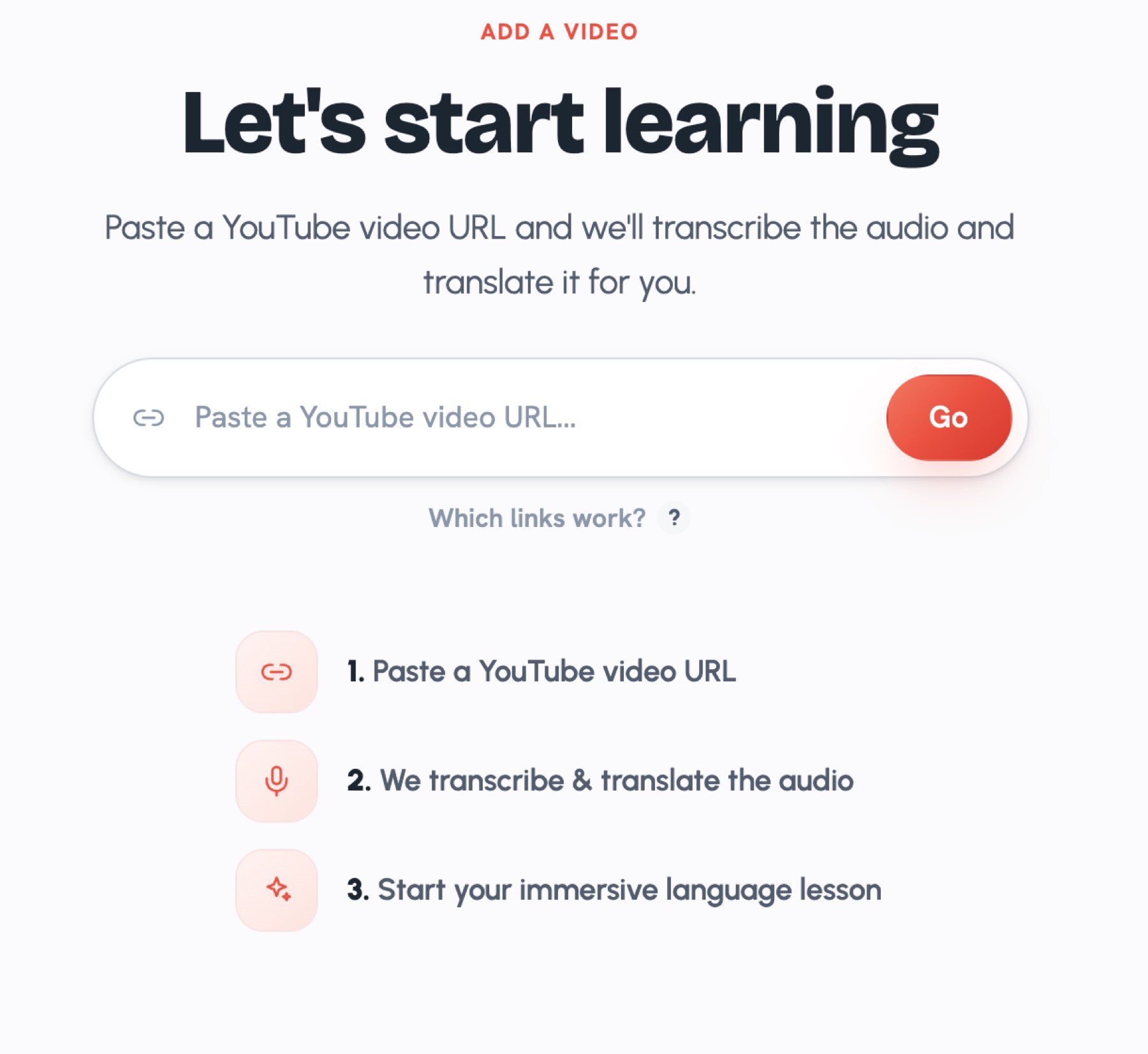
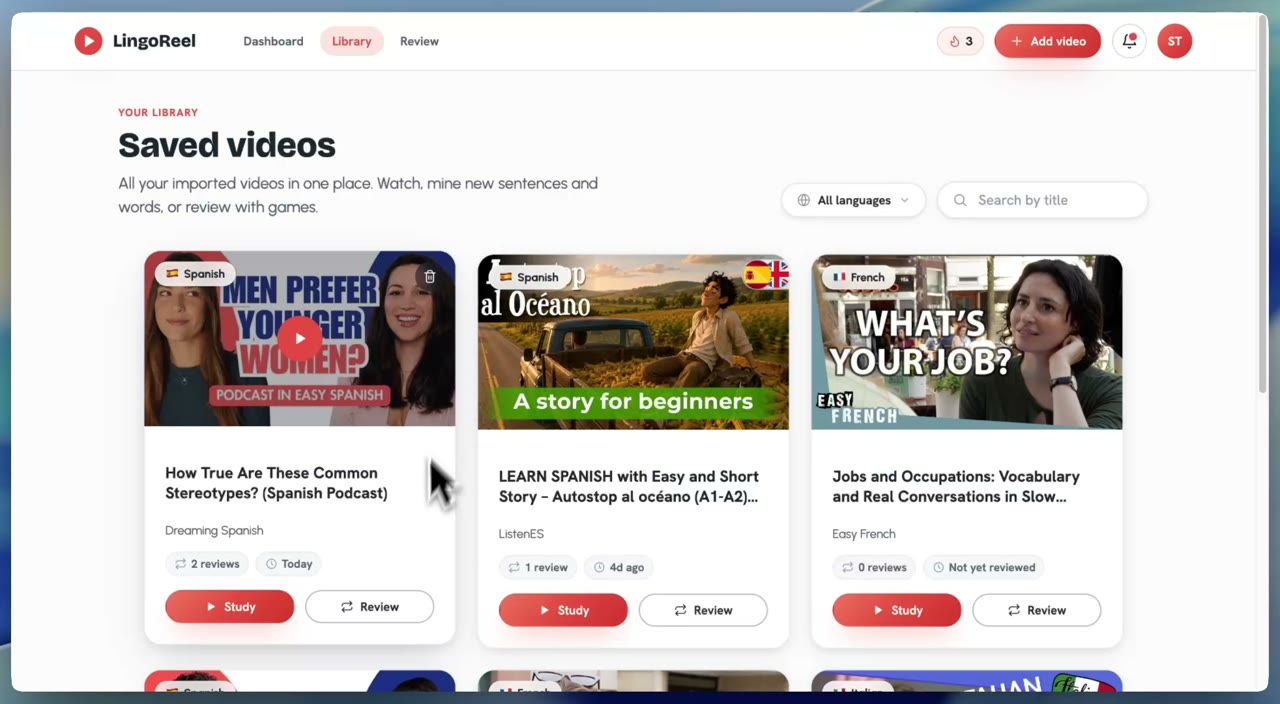
The whole drill hinges on having a trustworthy transcript, and that’s exactly what Korean video rarely comes with. Plenty of clips have no captions at all; the ones that do are often auto-captions that hear the assimilated, particle-dropped stream about as poorly as you do — and mislabel it, which teaches you the wrong sound. Worse for this drill, a caption track is on the whole time, so you never get to test your own ear before the answer appears. That’s the gap Parlune was built to close: paste any Korean YouTube link and it transcribes the audio itself into clean, audio-aligned Korean sentences you tap word by word — accurate even when the video carries nothing, and hidden until you choose to reveal it, so you can commit to what you heard first. We cover the whole category honestly in the roundup of tools for learning from YouTube, and where caption-first tools run out of road in our Language Reactor alternative piece.
Why eye-only review fails Korean specifically
There’s one more step after you’ve decoded a clip, and Korean makes it matter more than most languages do — again because of the sound changes. A flashcard that shows you 맛있어요 rehearses the spelling, and the spelling is the part your eyes already had. It tells you nothing about the 마시써요 your ears will actually meet at speed. Seeing a word and hearing a word are separate skills; conversation only ever tests the second one.
So when you mine sentences from a video, hold onto the audio of that exact moment and rehearse against it — play the clip, transcribe what you caught, rebuild the line from the sounds up. That’s how a word you decoded once turns into a word you’ll actually catch the next time it flies past — the difference between “I know this word” and “I understood the sentence.”
A week of Korean that actually moves the needle
- Most days, 15–20 min — easy input. One Comprehensible Korean or 태웅쌤 video, watched relaxed and for the gist. This is the volume that builds stamina; don’t sweat the words you miss.
- Two or three times a week, 10 min — one hard clip. Take something a notch above your comfort level and run the hear-it-then-spell-it drill on it until every sound change is accounted for.
- Once a week — bank what stuck. Save three to five lines that caught your ear, audio and all, and revisit them by ear over the following days so they don’t evaporate.
Keep it small and keep it honest. A quarter-hour of Korean you genuinely wrestle with does more than an hour of it playing to an empty room.
The short version
Korean gives up its writing system in an afternoon and its sound over months, because the tidy spelling never shows you the rules doing the real work: batchim that jump, blend and vanish, verbs and politeness that surface only at the end, particles that get swallowed whole. You can’t read your way past that, and you can’t absorb it from audio you let wash over you. You get past it by working up through three buckets of material — graded input, then short real conversation, then native video — always kept near that 70–80% band, using the hear-it-then-spell-it drill to reconcile the sound with the spelling and review on the original audio so what you decode once, you keep.
If you want the underlying approach in full, see our pillar on how to learn a language with YouTube the right way, or the honest roundup of tools for learning from YouTube if you’re weighing options.
Start with one Comprehensible Korean video today. And when a clip you’d genuinely watch keeps dissolving on you, run the hear-it-then-spell-it drill on it properly: Parlune transcribes the audio itself, hides it until you commit to what you heard, and then shows you exactly which 받침 moved. Plans from $14.99/month, no ads. Hangul took you an afternoon — the sound is the part worth the months.