In Italian, how long you hold a consonant can change the word entirely. Sono means “I am”; lean on the n for a beat longer and sonno means “sleep.” Pena is “sorrow,” penna is “pen.” Nono is “ninth,” nonno is “grandfather.” Italian is stitched together with these twins — pala/palla, casa/cassa, capello/cappello — and the only thing telling them apart is the length of a single sound. On the page your eye reads that doubled letter without effort. Spoken at speed, an ear trained on English tends to flatten it, and “ho sonno” (“I’m sleepy”) quietly becomes “ho sono,” which means nothing at all.
That is the small surprise waiting for most people who start Italian. It has a reputation as the easy Romance language: the spelling is famously phonetic, there are almost no silent letters, and after a few weeks you can read a menu or a headline and feel like you’re flying. Then a real Italian opens their mouth and the tidy, evenly-spaced words on the page arrive as one warm, fast, elided rush — and the reading confidence doesn’t come with you.
YouTube is the best free fix for that, because it holds more real Italian than you could watch in a lifetime — teachers who slow every syllable down, street interviews, history lectures, Neapolitan comedy. Leaving it running in the background won’t retrain your ear, though. What does is comprehensible input aimed squarely at listening: material you can follow now, climbing toward native speed — the same loop we lay out for learning any language from YouTube. This piece is that method for Italian specifically, plus the real, named channels worth your time at each level.
Three things about spoken Italian that your reading never taught you
Italian rewards reading early and punishes listening late. Here’s the specific reason the two skills split so far apart.
1. Double consonants carry meaning, and they’re easy to miss. The sono/sonno problem from the opening isn’t a curiosity — Italian has thousands of these minimal pairs (papa, “pope,” vs pappa, “baby food,” and so on), and a geminated consonant is genuinely held longer in speech. English doesn’t do this, so beginners’ ears simply don’t register the extra length, which means both the word you meant and the word you didn’t sound identical to you. Auto-captions struggle here too, dropping or adding a letter and teaching you the wrong spelling.
2. Italian is spoken joined-up, with vowels doing the connecting. Written out, non lo so (“I don’t know”) is three neat words; said at pace it’s closer to a single “nlosò.” Italian elides constantly — l’amico, un’ora, dov’è — and fuses prepositions into articles (di + il → del, in + la → nella), so word boundaries you can see on the page evaporate in the audio. On top of that, the vowels aren’t all equal: pèsca (open è, “peach”) and pésca (closed é, “fishing”) are spelled the same and mean different things, and which one you get shifts by region.
3. There is no single “Italian” accent. Standard TV Italian is only the starting point. A Roman doubles consonants that a northerner doesn’t; Neapolitan and Sicilian speech can feel like a different language; Milanese is clipped and fast. And the congiuntivo (subjunctive) that textbooks treat as advanced is alive and constant in everyday speech — “penso che sia”, “volevo che tu venissi.” Your ear needs a spread of real voices, not one narrator reading slowly forever.
The single fix for all three is the same: hear a lot of real Italian while an accurate transcript runs beside it, so your eyes show your ears where the doubles are, where one word ends, and which vowel is really being said. That’s the entire method — the rest is choosing the right videos.
A three-tier climb: meet Italian where you actually are
The mistake is treating “watch Italian on YouTube” as one thing. It’s really three, and you move up through them rather than leaping to the top and drowning.
- Made-for-learners input — a teacher speaking slowly and visually so you understand now, roughly three-quarters of it without translation. This is where acquisition genuinely starts.
- Semi-real content — vlogs, story channels and street interviews: real voices and real speed, but on a followable topic and usually subtitled.
- Native content made for natives — the comedians, lecturers and news channels you’ll still be watching once you’re fluent. Above your level today; the aim is to pull them into reach now instead of waiting a year.
The rough target is understanding about three-quarters of what you hear at whatever tier you’re on. Much below that and it’s noise; well above it and you’ve stopped learning. When a tier starts to feel comfortable, climb.
Tier 1 · Beginner — teachers who make sure you follow
These creators speak slowly and clearly, and explain the tricky bits in English where it helps. Start here even if you can already read a fair amount.
- Italy Made Easy — Manu is superb at taking the parts of Italian that scare beginners (verb conjugations, when to use which past tense) and making them make sense in plain English, then drilling them in slow Italian. The best first channel for building a foundation you understand rather than memorise.
- Learn Italian with Lucrezia — Lucrezia Oddone teaches grammar and pronunciation clearly, then puts it to work in gentle, personable vlogs about daily Italian life, spoken in Italian with Italian subtitles. Her pronunciation videos are the place to actually hear the double-consonant and open/closed-vowel distinctions above.
- Italiano Automatico — Alberto built the channel squarely on the comprehensible-input idea: learn by listening to a lot of Italian you can follow. His slower storytelling episodes are ideal extensive listening once you have a few hundred words.
Stay here until slow, clear Italian feels easy — usually when you can follow one of Lucrezia’s vlogs without pausing every line.
Tier 2 · Intermediate — real Italian, still within reach
Now you want actual Italians talking, with enough support that you’re not lost. This is the tier where most learners get stuck, camping on beginner lessons or jumping straight to native comedy and bouncing off it. These channels are the bridge.
- LearnAmo — Graziana and Rocco teach almost entirely in Italian and, crucially, label videos by CEFR level (A1–C2), so you can dial the difficulty to exactly your rung. Excellent for the slang, idioms and register that textbooks skip.
- Podcast Italiano — Davide Gemello, a teacher from Turin, speaks clear, natural Italian entirely in Italian and publishes full transcripts. His “Italiano in 7 minuti” and interview episodes are the model of semi-real content, and there’s a separate Principiante strand if the main one is a stretch.
- Italian Comprehensible Input — a channel built around vlog-style videos designed to be understood from context, no English. Perfect for getting your ear onto ordinary conversational rhythm without a lesson framing.
The goal here isn’t every word — it’s following the gist and letting the unknowns wash past. When you can do that comfortably, you’re ready for the real thing.
Tier 3 · Advanced — Italian made for Italians
This is the payoff: full-speed Italian with all the regional colour, doubling and subjunctive live. You won’t catch everything at first, and that’s the point — you work short pieces of it until you can.
- Barbascura X — science explained as comedy (“Scienza Brutta”), fast and dense, in a distinctly Southern (Taranto) voice. A genuine ear workout, and funny enough that you’ll keep going.
- Breaking Italy — Alessandro Masala’s near-daily current-affairs commentary in quick, clear standard Italian. Ideal if you’d watch the news in English anyway; the vocabulary compounds fast because the topics recur.
- Casa Surace — hugely popular sketch comedy about southern students living up north. It’s your window into regional Italian and the “terrone fuori sede” experience — the Campania accent and family-dinner cadence you won’t hear on the news.
If full native speed is still a wall, the historian Alessandro Barbero’s lectures are a gentler on-ramp within this tier — standard, beautifully articulated Italian at a measured pace, and gripping if you like history. He has no channel of his own; Alessandro Barbero – We Are History is where the talks are collected. Whatever you pick, choose a creator whose topic you’d watch in English anyway — the best video is the one you’ll actually finish.
Catching the doubles: let a transcript show your ear what it’s smoothing over
Here’s the move that turns native Italian from “too fast” into study material you can use today. Take a clip you like — twenty or thirty seconds — and work it in three passes:
- Listen with no text. Try to catch every word, and specifically notice where you can’t tell whether a consonant was single or double, or where three words blurred into one.
- Reveal an accurate transcript and listen again. This is where the blur resolves: you see the nn in sonno, the elision in dov’è, the nella that your ear heard as ne-la. Your eyes teach your ears the boundary they couldn’t find alone.
- Hide the text and listen once more. Now that your brain knows what’s there, you’ll hear it — and that re-hearing is the rep that sticks.
The friction has always been that transcript. Most Italian YouTube videos have no captions, and the auto-captions that do exist are unreliable exactly where Italian is hard — fast joined-up speech, doubled consonants, regional accents and slang are precisely what they garble. Caption-based study tools inherit that problem, because they read whatever caption track the video already has. (We compare the whole category honestly in the best tools for learning a language from YouTube, and dig into where caption-first tools run out of road in our Language Reactor alternative piece.)
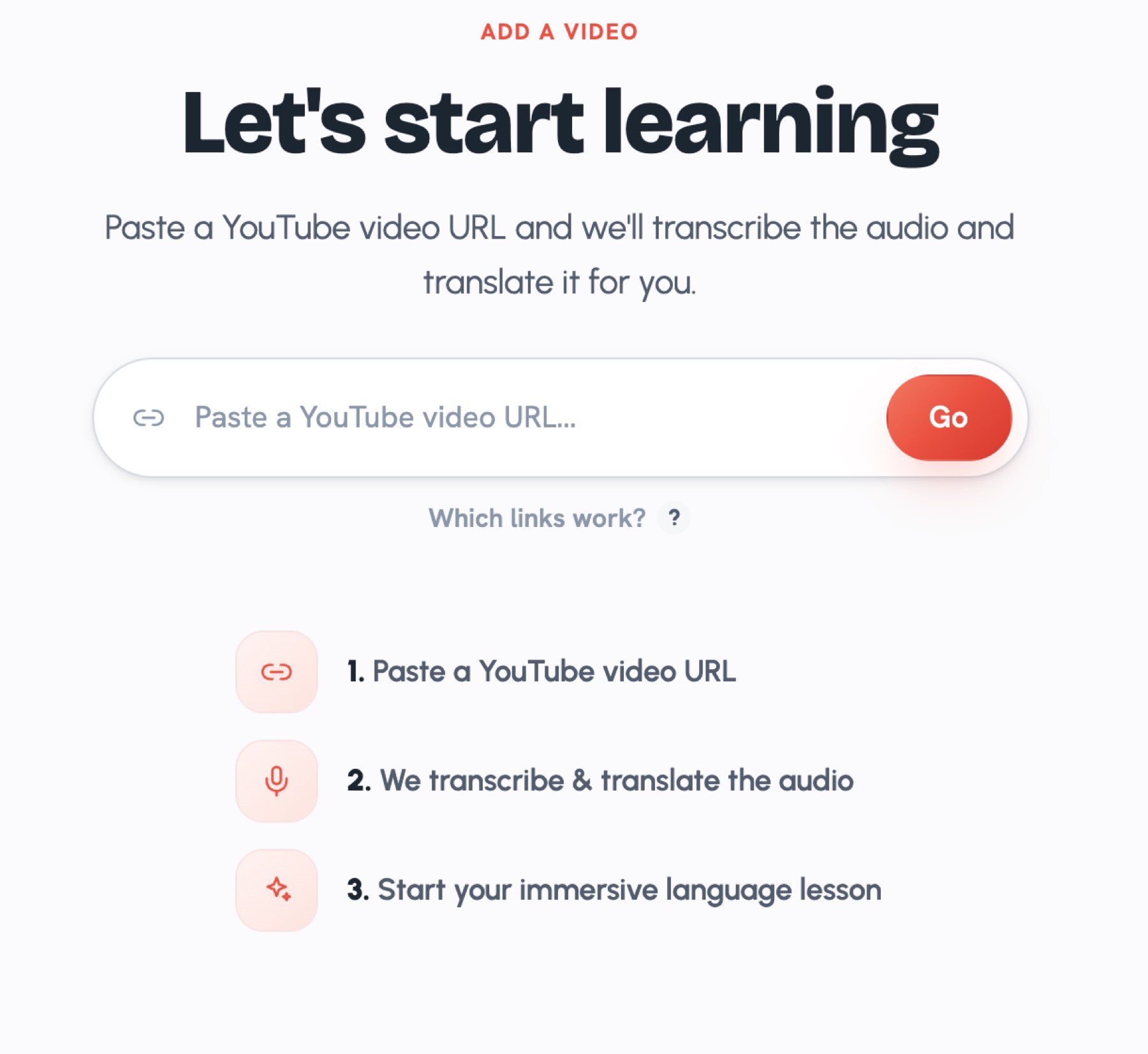
This is the gap Parlune was built to close. Paste any Italian YouTube link and it transcribes the audio itself — not the caption track — into clean, accurate, audio-aligned sentences, so the text is right even when the video has none. You can listen to a line blind, then reveal exactly what was said, and finally connect that melted “nlosò” to non lo so. Tap any word and it’s saved with its full sentence and the exact native clip it came from — which sets up the last piece.
Review with the sound, not just the spelling
Italian punishes eye-only review more than you’d expect, precisely because the spelling looks so learnable. A flashcard showing sonno tells you nothing about the held n that separates it from sono in speech, and recognising penna on a card is not the same as catching it when it flies past inside a sentence. If you save new words to cards that only show the written form, you’ve dropped the hardest half of the work.
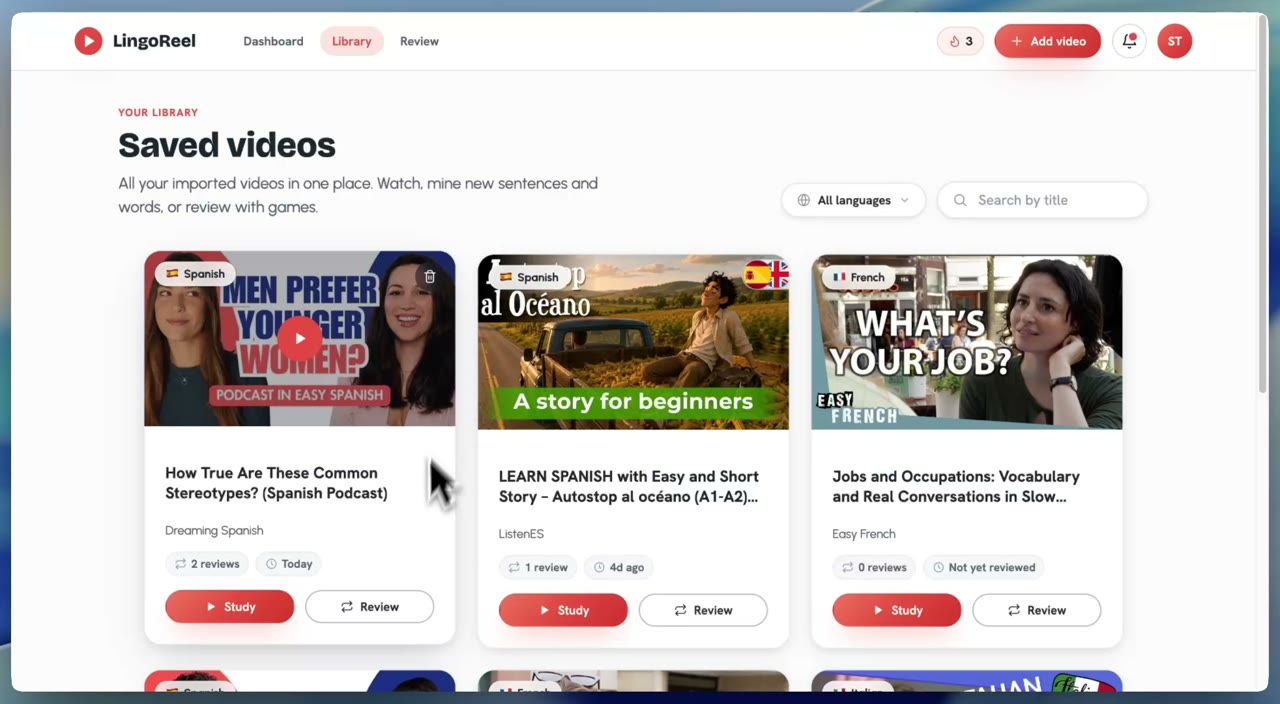
So when you mine sentences from a video, keep the audio of the exact moment, and review on that clip: hear it, recall the meaning, take dictation. That’s how a word you decoded once becomes a word you’ll actually catch next time — and it’s the difference we go deep on in training your listening so native speech stops sounding like one long word.
A week of Italian you can actually keep up
You don’t need hours. Fifteen honest minutes of Italian you understand beats an hour of noise.
- Daily (15–20 min): one Italiano Automatico or Podcast Italiano episode at your level as relaxed, gist-level listening — building stamina.
- A few times a week (10 min): one short clip from a tier above yours, worked with the listen-blind-then-reveal pass until you can hear every double and boundary.
- Weekly: mine three to five sentences you liked, with their audio, and review them by ear across the week, listening specifically for single-versus-double consonants.
That loop — pick real Italian, make it comprehensible, mine words in context, review by ear — is the whole method, and it’s the same one behind how to learn a language with YouTube the right way.
Press play on real Italian today
Italian is genuinely one of the most rewarding languages to study this way: the spelling gives you a fast start, there’s a deep well of funny, warm, regionally varied content to climb through, and the one thing standing between reading it and hearing it — those doubled consonants and joined-up vowels — is exactly the thing an accurate transcript plus review-by-ear is built to fix.
Choose a tier, choose a channel, and press play. Then let one native clip do the teaching: paste it into Parlune, listen before you look, and watch that melted “nlosò” resolve into non lo so with every double consonant where it belongs. Subscription plans from $14.99/month. The geminates are audible — you just have to be shown, once, where they are.