Write out नमक — “salt” — one Devanagari letter at a time and you get three beats: na-ma-ka. Say it the way anyone in Delhi says it and the last vowel simply vanishes: “namak.” Nothing on the page told you to drop it. Hindi’s script gives every consonant a built-in a sound, then quietly deletes some of them by rules it never writes down — so the word you can spell letter-perfect is not the word your ear has to catch. That gap, between the Hindi you can read and the Hindi you can hear, is the real wall, and it’s a listening problem long before it’s a vocabulary one.
YouTube is the best place to knock that wall down — it holds a firehose of genuine Hindi, from teachers who slow every syllable to 40-million-subscriber comedians talking a mile a minute. But hours of it playing past you won’t retrain your ear on its own; that takes comprehensible input aimed at listening and climbed in order, which is the whole idea behind learning any language from YouTube. Rather than re-argue that here, this piece does the Hindi-specific part: why Hindi is hard to catch, a ladder built around it, and the real, named channels to press play on at each rung.
Why Hindi slips past your ear (even after you’ve studied it)
Plenty of people can sound out Devanagari and recognise a few hundred words, then hear a shopkeeper or a vlogger and catch almost nothing. That isn’t slowness. Four features of spoken Hindi make listening its own separate skill.
The script hides the sounds, not just the schwa. Devanagari is an abugida — क isn’t “k,” it’s “ka,” a consonant with a vowel already fused on. Reading is a constant act of deciding which built-in vowels survive and which get swallowed, and that decision isn’t printed anywhere. So even a clean, correctly-spelled sentence can leave you unsure what it’s actually supposed to sound like until you’ve heard it.
Hindi splits sounds English lumps together. The single English “d” covers two distinct Hindi consonants: a dental द (tongue on the teeth) and a retroflex ड (tongue curled back). They’re a real minimal pair — दाल (dāl, lentils) versus डाल (ḍāl, a branch). On top of that, aspiration changes meaning: क (ka) and ख (kha) are different letters and different words. English speakers hear both distinctions as “the same sound,” so their ears file two words as one until enough real audio pulls them apart.
The grammar shifts under your feet by gender. Hindi verbs and adjectives agree with the gender of the noun — and even with the speaker’s own gender. “I want to learn Hindi” is मुझे हिंदी सीखनी है (mujhe hindī sīkhnī hai), where सीखनी takes a feminine ending because हिंदी is feminine; a man saying “I go” says jātā hūñ, a woman jātī hūñ. These endings are short, unstressed, and fly by — exactly the kind of tiny signal you only start hearing after a lot of listening.
Real Hindi is often half English. Everyday spoken Hindi — especially the urban Hindi that fills YouTube — code-switches constantly: an English noun dropped into Hindi grammar, a whole clause flipping languages mid-sentence (“matlab it’s basically free, yaar”). Textbook Hindi never prepares you for it, and it’s brutal on auto-captions, which routinely mis-detect which language is even being spoken — a problem Google openly doesn’t fix.
The single fix for all four is the same: hear a lot of real Hindi while an accurate transcript shows you where the words break and which sounds you merged — so your eyes teach your ears.
The ladder: three rungs, climbed in order
Treating “watch Hindi YouTube” as one activity is why most people stall. It’s three different jobs, and you earn your way up:
- Made-for-learners input — a teacher speaking slowly and visually so you follow now, mostly without translation. This is where the ear actually starts to form. It matters more in Hindi than in many languages, because the obvious “real” content (vlogs, comedy) is fast and English-laced — jumping straight to it teaches you very little.
- Bridge content — clear, real Hindi on a followable topic: graded podcasts, news explainers, slow storytelling. Real speed and real vocabulary, but articulate and supported.
- Native content made for Indians — the vloggers, comedians and creators you’ll still watch once you’re fluent. Out of reach today; the goal is to drag them into reach now instead of waiting a year.
A useful gauge: pick material where you follow the thread without subtitles roughly three times out of four. Much less and it’s noise that doesn’t stick; much more and you’ve stopped learning. When a rung stops being work, climb.
Rung 1 — Beginner: channels built to be understood
Start here even if you’ve “done some Hindi.” These creators are engineered so you understand from day one.
- Comprehensible Hindi — the reference point for the whole input method in Hindi. Pawan speaks entirely in Hindi but draws, points and repeats so you follow with zero English, graded from absolute beginner upward. If you watch one channel, watch this one — it trains your ear on natural rhythm before your eyes get attached to spelling.
- Learn Hindi with HindiPod101 — the biggest structured library, with playlists sorted cleanly by level and English explanations. Best when you want a syllabus and grammar spelled out rather than pure immersion.
- Anil Mahato — a native teacher who explains spoken Hindi, grammar and pronunciation in English across hundreds of videos. The go-to for “wait, why did the verb ending change?” moments — especially the gender agreement above.
Stay on this rung until slow, clear Hindi feels comfortable — roughly when you can follow a Comprehensible Hindi beginner video without pausing every line.
Rung 2 — Bridge: real Hindi, still followable
Now you want real speech, but with enough support that you’re not drowning — the rung where most learners either camp on beginner videos forever or leap to comedy sketches and bounce off.
- Comprehensible Hindi — intermediate and advanced playlists — the same channel grades upward into longer, faster, real-topic monologues that are still built to be understood. The most natural next step from Rung 1.
- The Lallantop — one of India’s biggest Hindi-language news and explainer channels. News anchors enunciate, the topics are concrete and current, and segments are short — which makes it a rare bridge where the speech is genuinely native but the diction is clean enough to track.
- Dhruv Rathee — long explainer videos on politics, science and current affairs, delivered in unusually measured, carefully-enunciated Hindi with heavy on-screen visual support. Nothing about it is made for learners, but the deliberate pace and the graphics carrying half the argument make it the best stamina-builder on this rung.
The aim here isn’t every word — it’s holding the gist while the unknowns wash past. When you can do that comfortably on The Lallantop, you’re ready for the real thing.
Rung 3 — Advanced: native content made for Indians
This is the payoff and what keeps you watching for life — full-speed Hindi with all the code-switching, slang and swallowed vowels live. You won’t catch everything, and that’s the point; you take short pieces and work them until you can.
- Flying Beast — Gaurav Taneja’s daily family vlogs in everyday North-Indian Hindi, thick with the casual Hinglish that textbooks pretend doesn’t exist. The gentlest on-ramp to “a real person just living their life.”
- BB Ki Vines — Bhuvan Bam’s comedy sketches (26M+ subscribers) in hyper-colloquial Delhi Hindi and slang. This is how young people actually talk — fast, playful, and nothing like a lesson.
- CarryMinati — rapid-fire roast comedy at the very top end of speed. Treat him as the exam: if you can follow CarryMinati, ordinary conversation will feel slow.
Beyond these, pick a creator whose subject you’d watch in English anyway — tech, cricket, cooking, gaming. Enjoyment is what buys you the hundreds of hours fluency actually costs. The trap on this rung is passive watching; native content only levels you up if you occasionally stop and decode — which is the next part.
Ears first, then eyes: the drill that makes hard videos usable now
You don’t have to wait until you’re “advanced” to study advanced Hindi. You just work it in short pieces. The most effective drill takes a few minutes:
- Play a short clip — ten to thirty seconds — with no text at all. Just your ears. Try to catch every word; replay it two or three times.
- Now reveal the transcript and listen again while reading. This is the moment you see exactly where दाल ended and the next word began, or which schwa you’d wrongly kept — and a blur snaps into मुझे समझ आ गया (“I got it”).
- Hide the text and listen once more. Now that your brain knows what’s there, you’ll actually hear it. That re-hearing is the rep that sticks.
Catching the gap, then hearing it correctly, is the mechanism of listening improvement — there’s a full walkthrough in our guide to training your ear so native speech stops sounding like one long word.
The friction has always been the transcript. Most Hindi videos have no captions, and auto-captions choke exactly where Hindi is hardest — mis-detecting Hindi-versus-English in code-switched speech, garbling retroflex and aspirated consonants, and pinning schwas that natives drop. And the caption sits on screen the whole time, so you can never listen blind first. That’s the gap Parlune was built to close: paste any YouTube link and it transcribes the audio itself — not the video’s caption track — into clean, audio-aligned Hindi sentences you can tap word by word, accurate even when the video has no captions and even through Hinglish. You hear a line, then reveal the exact words. (We compare the whole category honestly in the best tools for learning a language from YouTube, and cover where caption-first tools run out of road in our Language Reactor alternative piece.)
A card with the spelling teaches you the easy half
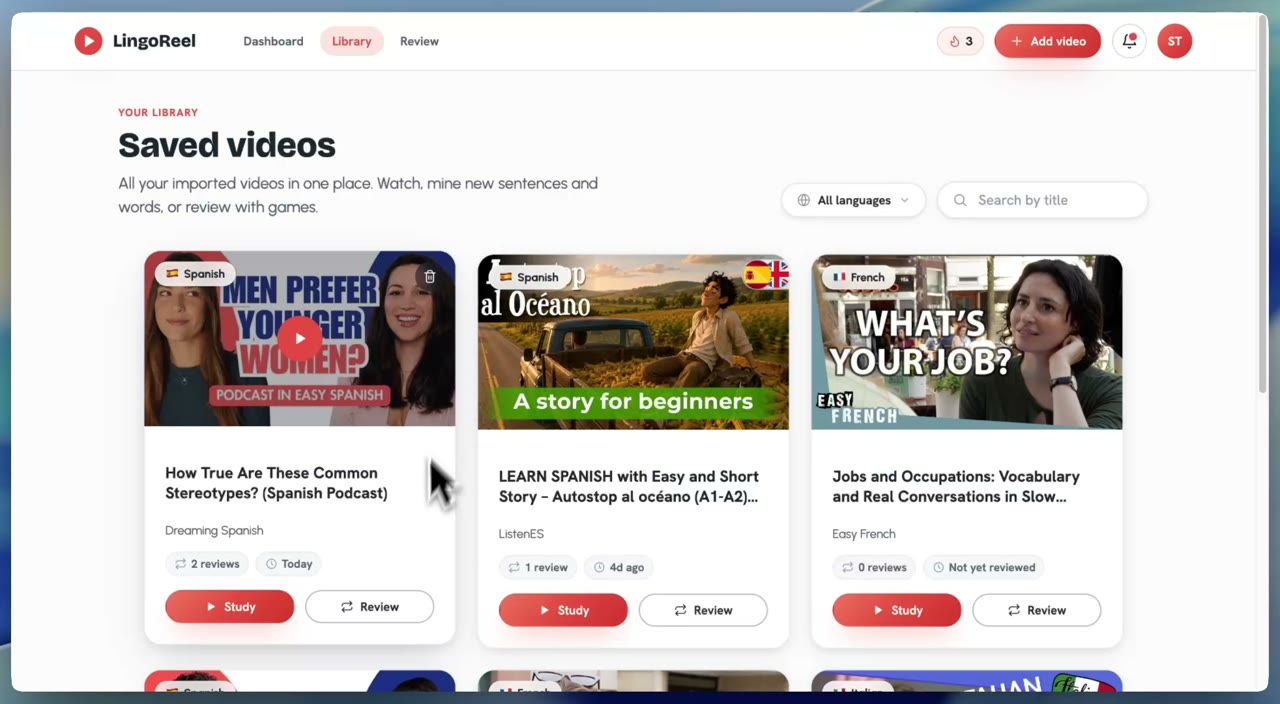
What happens after you decode a clip decides whether it sticks — and Hindi punishes eye-only review harder than most languages. A word you can read in Devanagari tells you nothing about whether its द was dental or retroflex, or which vowel gets swallowed at speed. Save it to a card that shows only the written form and you’ve dropped the hardest half of the work.
So when you mine sentences from a video, keep the audio of the exact moment and review on that clip: catch the word by ear, take dictation, reorder what you hear. That’s how a word you decoded once becomes a word you’ll catch next time it flies past — the difference between “I recognise this spelling” and “I understood the sentence.”
A realistic weekly routine
- Daily (15–20 min): one Comprehensible Hindi episode as relaxed, gist-level listening — building stamina, not straining.
- A few times a week (10 min): one short clip from a rung above yours — a Lallantop segment, then later a Flying Beast vlog — worked with the ears-first drill until you can hear every word.
- Weekly: mine three to five sentences you liked, with their audio, and review them by ear across the week, including the code-switched ones — Hinglish is real Hindi.
Fifteen honest minutes of Hindi you actually work beats an hour of background sound you don’t.
The honest summary
Hindi is hard to catch by ear because its script hides which sounds survive, it splits consonants English merges (दाल vs डाल, क vs ख), its endings shift by gender, and real speech is laced with English — none of which reading practice or passive audio will fix. What fixes it is a ladder: made-for-learners input, then clear bridge content, then native video, climbed at roughly three-in-four comprehension, with short ears-first listening to un-blur fast speech and audio-based review so the gains last.
For the method underneath all of it, see our pillar on how to learn a language with YouTube the right way, or the honest roundup of tools for learning from YouTube if you’re weighing options.
Start with one Comprehensible Hindi video tonight, and save the ears-first drill for a video you’d actually choose. That’s where Parlune earns its place: paste a Hindi link and it transcribes the real audio — Hinglish and all — so you hear the line first and then see which schwas survived. Subscription plans from $14.99/month, no ads and no relying on YouTube’s captions. नमक is spelled with three beats and said with two; everything else in Hindi listening is that same gap, closed one clip at a time.