In German, the part of the verb that tells you what is actually happening often doesn’t arrive until the end of the sentence. A friend says Ich ziehe nächste Woche in München aus and you catch ziehe — “pull,” “move” — early on, but whether she’s moving out (ausziehen), moving in (einziehen), or just getting dressed (anziehen) is settled by one small syllable, aus, that lands four words later, right at the very end. German routinely splits its verbs and parks the meaning-bearing half last, so your ear has to hold the whole clause open and wait for the payoff.
Reading lets you glance ahead to that final word. Your ear gets no such shortcut — which is a large part of why German you can comfortably read on the page turns to fog the moment someone speaks it at normal speed. That distance between reading German and hearing it is the real wall, and it’s a listening problem, not a vocabulary one.
YouTube is the obvious place to fix that: it holds more real German than you could watch in a lifetime, from teachers who slow every syllable down to Berlin street interviews and machine-gun science channels. But hours of it running in the background won’t retrain your ear on their own. What does is comprehensible input pointed at listening — material you can follow now, climbing toward native speed — the same loop behind learning any language from YouTube. This page is the German-specific version: what makes German hard to hear, the channels worth your time at each level, and a drill built around those late-arriving verbs.
The German your textbook never played out loud
Most people who “know some German” built that knowledge with their eyes — a course, an app, tables of der/die/das. Then they hear it and it collapses into one fast, front-heavy blur. That isn’t slowness on your part. German has a few specific habits that make listening a genuinely separate skill from reading.
The verb finishes late — sometimes very late. Separable verbs (like the ausziehen above) fling their prefix to the end of the clause: Ich stehe um sechs auf (“I get up at six”) only becomes get up rather than plain stand when that final auf lands. And in any subordinate clause the whole finite verb moves to the end: …, weil ich das Video noch nicht gesehen habe. Your ear has to keep the entire clause suspended and resolve it at the last word — a load that reading simply doesn’t impose.
Words fuse and endings devoice. German loves compounds that run together into a single unbroken stress-unit — Geschwindigkeitsbegrenzung (“speed limit”), Krankenversicherung (“health insurance”), Handschuhe (literally “hand-shoes,” i.e. gloves). Spoken, they arrive as one long word your ear has to split on the fly. On top of that, final consonants devoice, which quietly manufactures homophones: Rad (“wheel/bike”) and Rat (“advice”) both come out “raht”; seit (“since”) and seid (“[you] are”) are both “zait.” Same sound, different word — only context tells them apart.
The sounds themselves need calibrating. There’s the split between the soft ich-sound [ç] and the throaty ach-sound [x] (compare ich and Buch), the -ig ending that’s pronounced “-ich” (richtig → “RICH-tich”), the umlauts ö and ü, and a word-final r that melts into a vowel (Uhr → “oo-ah”). None of this is exotic once your ear expects it — but it has to hear a lot of it first.
The remedy for all of it is the same: hear plenty of real German while you can see an accurate transcript, so your eyes teach your ears where each word begins, ends, and finally resolves. Passive watching alone won’t get you there — you need input you can actually follow and a method for working it; the full case for that is in comprehensible input, explained. The rest of this page is about doing it well in German specifically.
Choose your tier by what you can follow — not by how long you’ve studied
The common mistake is treating “watch German on YouTube” as a single activity. It’s really three tiers, and the one that helps you is whichever you can follow at roughly 70–80% without translation. Below that it’s noise and nothing sticks; comfortably above it and you’re revising, not learning. When a tier starts to feel easy, move up.
Years spent studying is a poor guide here — plenty of people with a shelf of grammar books still can’t follow tier two by ear, because reading built one skill and listening is a different one. Go by comprehension, not by how advanced you feel you ought to be.
Tier 1 — Made to be understood
These creators speak slowly and visually, so you follow from the first video. Start here even if you’ve “done some German” — the point is to train your ear on real rhythm at a speed you can keep up with.
- Comprehensible German — pure comprehensible input, entirely in German, no grammar drills. Hannes builds meaning from context and repetition so you understand without translating in your head. The closest German equivalent to what Dreaming Spanish did for Spanish learners, and the best single place to begin.
- Natürlich German — Anna teaches through story-listening (TPRS): she tells simple, engaging stories with drawings and gestures, graded from super-beginner upward, so you acquire vocabulary and word order without ever sitting down to memorise a table.
- Deutsch für Euch — when a grammar point genuinely won’t click (cases, the separable verbs above, word order), Katja explains it clearly in English with real examples. This is the “why does German do that?” channel — use it to unblock, not as your main listening.
Stay here until slow, clear German feels comfortable — roughly when you can watch a Comprehensible German beginner video and follow the thread without pausing every line.
Tier 2 — Real German with a handrail
Now you want actual people at real speed, but with enough support that you’re not drowning. This is the tier where most learners stall — the notorious “B1 plateau” — because they either camp on beginner content forever or leap to native talk shows and bounce off. These channels are the bridge across.
- Easy German — unscripted street interviews from Berlin and beyond, with dual German/English subtitles. You get real accents, filler words, and the reductions textbooks hide (“haben wir” crushed to “hamwer,” “hast du” to “haste”), but in short, captioned, followable chunks. Their Super Easy German strand is a gentle on-ramp if regular episodes feel too fast.
- DW Learn German – Nicos Weg — Deutsche Welle’s free A1→B1 drama follows Nico, a young Spaniard landing in Germany and dealing with exactly what a learner deals with: flat-hunting, paperwork, making friends. It’s structured, subtitled, and paced for comprehension while still sounding like real conversation.
- Simple German Network — clear, slightly-slowed German on everyday topics, leaning on stories and synonyms so you can follow by audio alone. Ideal for building listening stamina on genuine speech once Easy German interviews feel within reach.
The goal here isn’t every word — it’s following the gist and letting the unknowns wash past. Crucially for German, practise holding a clause to its end: let the sentence finish before you decide what it meant, because the verb often hasn’t landed yet.
Tier 3 — Made for Germans, not for learners
This is the German you’ll keep watching once you’re fluent — full speed, real reductions, no concessions. You won’t catch all of it today, and that’s fine; the move is to take short pieces and work them (see the next section) rather than passively marinate.
- Dinge Erklärt – Kurzgesagt — the German edition of Kurzgesagt: gorgeously animated explainers on science, space, and politics, narrated in crisp, clear German. The animation carries a lot of the meaning, which makes it the gentlest first step from “learner content” into “made for natives.”
- MaiThink X — chemist Mai Thi Nguyen-Kim (formerly maiLab) breaks down science and current health topics in fast but exceptionally articulate German. The diction is clean and the arguments are structured, so it’s dense listening that stays followable — a favourite step up from Kurzgesagt.
- MrWissen2go — Mirko Drotschmann covers politics, history, and current events in a rapid talking-head format, aimed squarely at German teenagers and adults. High information density and native pace: when you can follow him, you can follow the news.
Pick whichever topic you’d watch in English anyway. Motivation beats “correct” material every time — the video you’ll actually finish is the one that teaches you.
The German-specific drill: listen to the end of the clause
Because German back-loads meaning — the separable prefix arrives last, the subordinate-clause verb arrives last — the useful unit to replay isn’t the word, it’s the whole clause. This drill costs a few minutes and is worth more than an hour of passive watching:
- Play one short clause — a phrase up to a full sentence — with no text. Just listen. Deliberately hold it open and wait for the ending: what was the final verb or prefix? Replay it two or three times and make a guess.
- Now reveal the transcript and listen again while reading. This is where you see exactly where the compound split, which ending devoiced, and how ausziehen was actually aus…ziehen stretched across the clause. You feel the click as the blur resolves.
- Hide the text and listen once more. Now that your brain knows what’s there — and where the verb finished — you’ll hear it. That re-hearing is the rep that sticks.
Training yourself to expect the payload at the end of the clause is the single habit that most improves German listening, and it generalises straight to real conversation. There’s a fuller walkthrough in our guide to training your ear so native speech stops sounding like one long word.
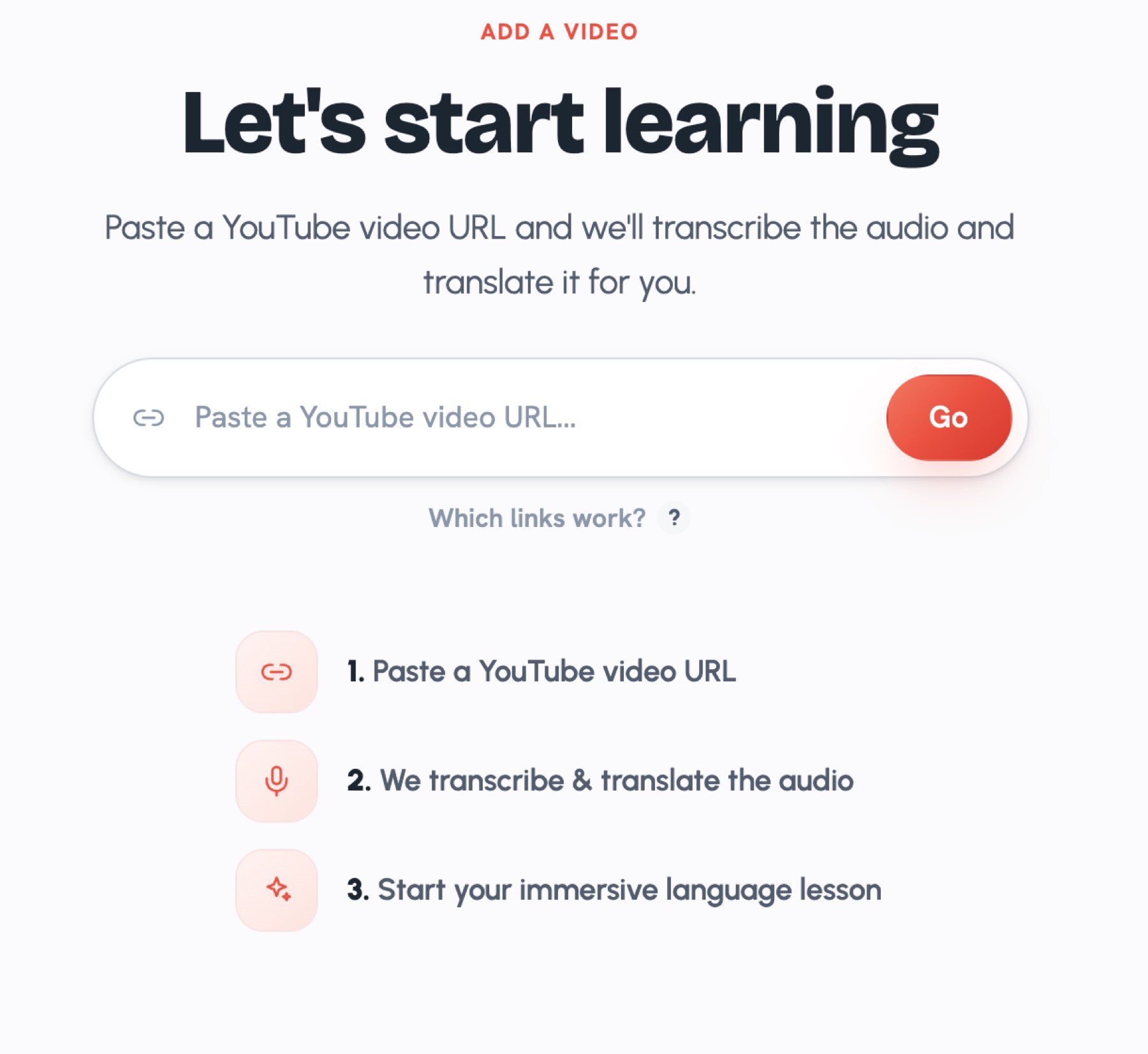
The friction has always been getting an accurate transcript to reveal. German auto-captions are unreliable exactly where German is hard: they split compounds in the wrong places, mangle regional speech (Swiss, Austrian, and Bavarian German throw them badly), and drop or garble the fast reductions — and the caption sits on screen the whole time, so you can never listen to the ending first. This is the gap Parlune was built to close: paste any YouTube link and it transcribes the audio itself — not the caption track — into clean, audio-aligned German sentences you can tap word by word, accurate even when the video has no captions at all. (We compare the whole category honestly in the best tools for learning a language from YouTube, and cover where caption-first tools run out of road in our Language Reactor alternative piece.)
Review by ear, because the page hides the sound
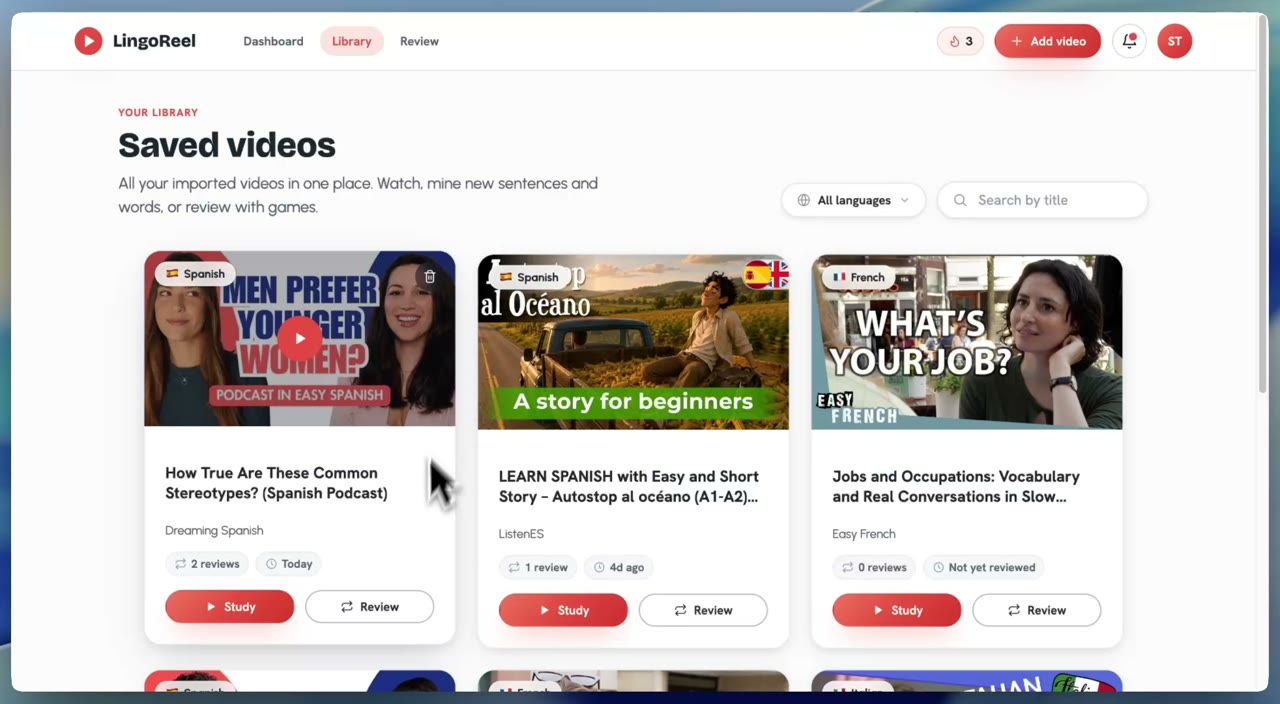
What happens after you decode a clip is where German gets remembered or forgotten. A word saved as text alone tells you nothing about how it devoiced, where it sat in the compound, or how it sounded crushed into fast speech — so eye-only review drops the hardest half of the work. When you mine a sentence from a video, keep the audio of the exact moment and review on that clip: hear it, recall the meaning, take dictation. That’s how Rad and Rat stop being a coin-flip, and how a word you understood once becomes a word you’ll actually catch next time it flies past with its verb hanging off the end.
A week that actually moves your ear
You don’t need hours — fifteen honest minutes of German you follow beats an hour of background noise.
- Daily (15 min): one Comprehensible German or Nicos Weg episode as relaxed, gist-level listening. Build the habit and the stamina.
- A few times a week (10 min): one short clip from a tier above yours, worked with the wait-for-the-ending drill until you can hear every word.
- Weekly: mine three to five sentences, keep their audio, and review them by ear — favouring long clauses, so you rehearse holding a sentence open to its final verb.
That loop — follow real German at your level, work short clips for the endings, mine in context, review by ear — is the whole method, and it’s the same one we lay out for any language in how to learn a language with YouTube the right way.
Start today
German is hard to catch by ear because it saves the verb for last, fuses its words into compounds, and devoices its endings into homophones — none of which reading practice fixes and none of which passive hours repair either. What fixes it is a ladder of followable input, climbed at 70–80% understanding, with short-clip listening that trains you to wait for the ending, and audio-based review so the gains hold.
Pick a channel from your tier and press play now. Then take the first native clip that defeats you — the sentence whose verb you never caught — and run it through Parlune: paste the link, get a transcript built from the audio rather than from YouTube’s captions, and listen again knowing what’s there. Plans from $14.99/month, no ads. The meaning was always at the end of the clause; this is how you learn to wait for it.