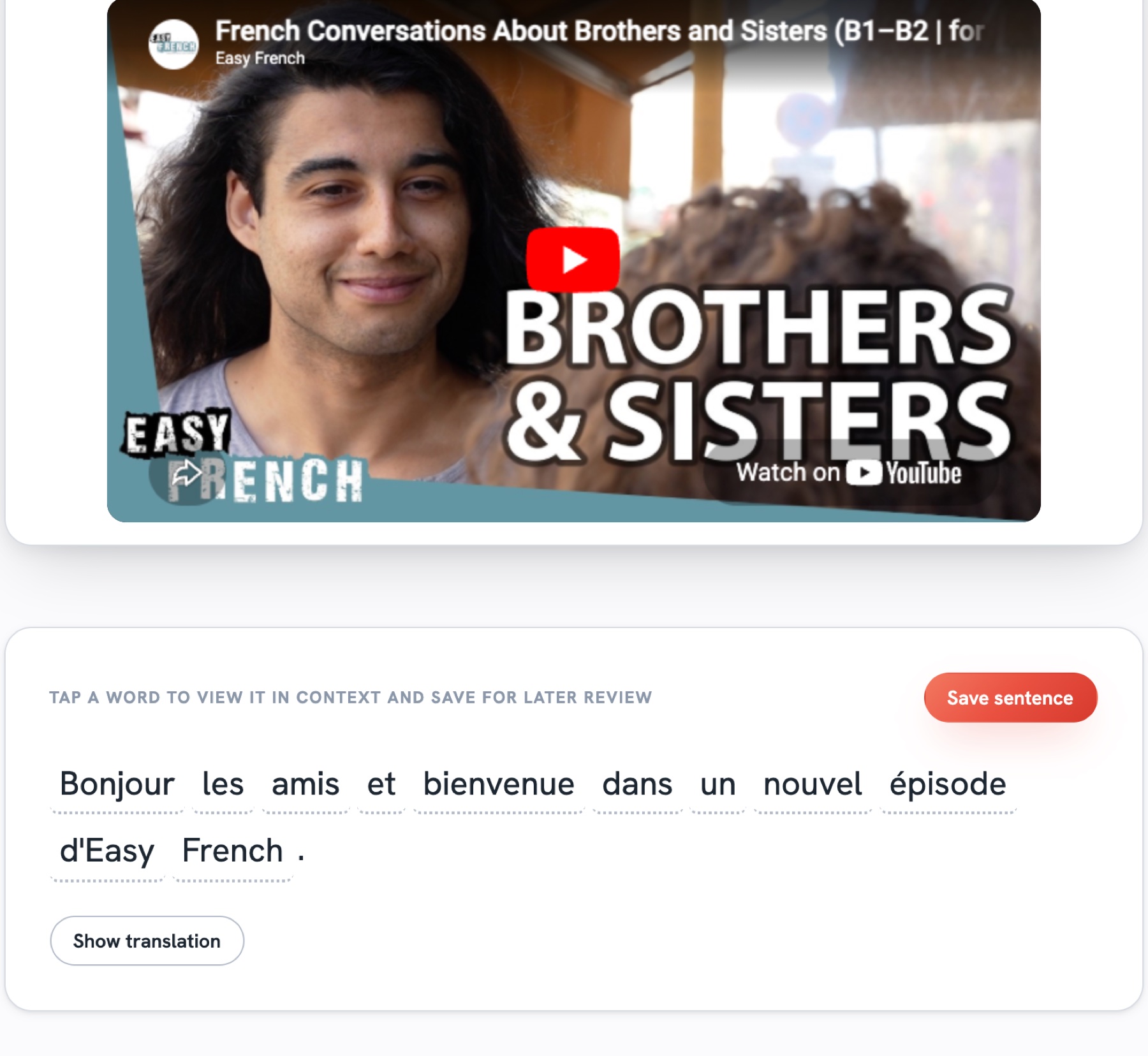
Say les amis out loud and the silent s on les refuses to stay silent — it leaps the gap, turns into a z, and welds the two words into one sound: “lay-za-MEE.” French does this everywhere. It tucks consonants away at the ends of words, then resurrects them the instant the next word opens with a vowel. It’s called liaison, and it’s the biggest single reason the French you glide through on the page smears into one continuous stream the instant a native opens their mouth.
Un-weaving that ribbon is exactly what YouTube is good for, because it’s wall-to-wall real French at every speed — teachers drawing each word on a whiteboard at one end, Parisian vloggers at full tilt at the other. It won’t happen from leaving a video running in the background, though. It happens through comprehensible input pointed at your ear: material you can genuinely follow, nudged up level by level toward native pace — the loop we set out in how to learn a language with YouTube. Rather than re-make that argument, this guide spends its words on what’s specific to French.
This is the French-specific version of that method, plus the exact channels worth your time at each level. Every channel below is real and named, so you can press play the second you finish reading.
Why French is hard to catch by ear (even when the reading feels easy)
A lot of French gets learned through the eyes — conjugation tables, an app streak, a grammar book — and reading it feels doable surprisingly fast. Then someone speaks and it turns to soup. That gap isn’t about being slow. French has a spelling-to-sound relationship that runs almost backwards from what a learner expects, and it works against your ear in three specific ways.
1. French writes letters it doesn’t say. A huge share of final consonants are silent, and whole grammatical endings disappear in speech. The result is homophones everywhere: ver, verre, vert and vers (worm, glass, green, towards) are four different words that all come out as a single “vair.” Il parle (“he speaks”) and ils parlent (“they speak”) are pronounced identically — “eel parl” — because the plural -ent ending is silent. So the word you see on the page and the sound that hits your ear routinely have a different number of pieces.
2. Then liaison puts consonants back — but only sometimes. The same silent letters come roaring back to bridge into a following vowel: nous avons → “noo-za-VON,” vous êtes → “voo-ZET,” comment allez-vous → “koh-mahn-ta-lay-VOO.” Word boundaries physically move depending on the next word. Your ear can’t rely on where the spaces are, because in sound they aren’t there.
3. Nasal vowels and dropped syllables finish the job. Un bon vin blanc (“a good white wine”) packs four nasal vowels English simply doesn’t have, and casual speech shaves words down hard: je ne sais pas collapses to “shsay-pah,” il y a becomes “ya,” and the ne of negation vanishes entirely in everyday talk. Textbook French keeps every syllable; spoken French throws half of them away.
There’s one fix that handles all three at once: hear plenty of real French with an accurate transcript in front of you, so your eyes show your ears where the liaisons land and which letters were never spoken in the first place. Everything below is built around making that possible.
Three stages, not one shortcut
“Watch French YouTube” isn’t a single activity — it’s three, and you’re meant to graduate through them in order. Trying to start at the top is why so many people bounce off native content and decide they’ve got no ear for languages.
- Made-for-learners input — a teacher speaking slowly and visually so you understand now, around 70–80% without translation. This is where acquisition actually begins.
- Semi-real content — street interviews and slow story channels: real accents and real speed, but short, on a followable topic, and subtitled.
- Native content made for natives — the vloggers, comedians and news channels you’ll still watch when you’re fluent. Out of reach today; the aim is to pull them into range now rather than in a year.
Park yourself wherever you land at 70–80% understanding. Much less and it’s just noise; much more and there’s nothing new to pick up. The moment a level feels easy, move up a rung.
Stage 1 — Beginner: channels built to be understood
The creators here slow right down and lean on drawing and gesture, so you’re understanding rather than translating from your very first video. Begin here even after years of French at school — school trained your eyes, and this is ear work from scratch.
- Alice Ayel — probably the best-known name in French comprehensible input. Alice tells stories entirely in French, sketching and pointing as she goes, always pitched just a notch above where you are so you follow with no English at all. Start with her if you start with anyone — she gets your ear onto natural French rhythm from video one.
- Français avec Pierre — Pierre explains grammar, pronunciation and real expressions clearly, with English support where it helps. This is the “why does French do that?” channel for when liaison, the subjunctive, or ne… pas dropping its ne won’t click.
- French Immersion — hundreds of hours of French-only comprehensible input, graded from absolute beginner upward. No English, an easygoing pace, and enough volume that you can stay on one channel for months without running dry.
Don’t rush off this rung. You’re ready to climb when you can sit through one of Alice’s beginner stories and follow the thread without hitting pause every line.
Stage 2 — Intermediate: real voices, real speed, still followable
Now you want real people, with just enough scaffolding that you’re not drowning. This is the rung people fall off — either they never leave the safety of beginner videos, or they jump straight to full-speed native vlogs and lose the thread completely. The three below are the handholds in between.
- innerFrench — built specifically for the intermediate plateau. Hugo talks about culture, history and ideas entirely in clear, articulate French, at a pace that makes grown-up topics reachable before you’re technically ready for them. It’s the closest thing to a cure for the “beginner stuff is boring, native stuff is too fast” trap. (More on that trap in breaking through the intermediate plateau.)
- Easy French — unscripted street interviews with dual French/English subtitles. This is where you first hear liaison and reduction in the wild, off real Parisians at real speed — but the clips are short and captioned, so it’s a controlled dose rather than a plunge.
- Piece of French — Elsa talks about everyday life in natural but intermediate-friendly French, no English crutch. It’s the natural next step once Easy French clips start feeling too short to stretch you — longer runs of connected speech to build stamina on.
Don’t aim to catch every word here. Aim to hold the thread and let the words you miss slide past — once that feels steady, native content is within reach.
Stage 3 — Advanced: native content made for natives
Here’s what you’re doing all this for — French made by French people for French people, full speed, every liaison and dropped ne live in the wild. You won’t catch all of it, and that’s fine: the move is to take small pieces and work them until you do.
- HugoDécrypte — fast, current news explained for a young French audience. Clear diction and on-screen context make it the gentlest on-ramp from “learner content” to genuinely native speech, and the daily format makes it a habit.
- Cyprien — comedy sketches at full conversational speed, thick with slang, wordplay and the reductions textbooks never show (“j’sais pas,” “y’a,” “chais plus”). If you can follow Cyprien, you can follow a French dinner table — it’s the speed test.
- Squeezie — France’s most-watched creator: gaming, challenges and vlogs in relaxed, rapid everyday French. Long-form and genuinely entertaining, which is exactly what earns you the hundreds of hours fluency actually takes.
Choose someone whose videos you’d click on in English anyway. What carries you to fluency is the hundreds of hours, and you only log those on content you actually enjoy — so a channel you love at 50% beats a “correct” one you tolerate at 80%.
The technique that makes hard videos usable now: hunt the joins
You don’t have to be advanced to study native French — you just work it in short pieces, and French rewards aiming at one target above all others: the joins, the liaisons and reductions where your ear loses track of where one word ends.
Grab a clip of ten to thirty seconds and work it like this: play it once or twice on audio alone and try to pin down every word, then bring up the transcript and play it again. That second pass is where the fog lifts — you catch that the mystery blur was vous avez run together as “voo-za-VAY,” or that “shsay-pah” was je ne sais pas with the ne dissolved out. Because you now know precisely what’s buried in the stream, the words surface on their own the next time you hear it. That “oh — that’s what that was” is the actual rep, and it compounds fast; there’s a fuller walkthrough in our guide to training your ear so native speech stops sounding like one long word.
The friction has always been the transcript. Plenty of French YouTube has no captions, and auto-captions garble exactly the parts you need — they mishear liaisons as different words and drop the reductions entirely — while sitting on screen the whole time, so you can never listen blind first. Caption-based study tools inherit that flaw, because they read whatever caption track the video already has. (We compare the whole category honestly in the best tools for learning a language from YouTube, and where caption-first tools run out of road in our Language Reactor alternative piece.)
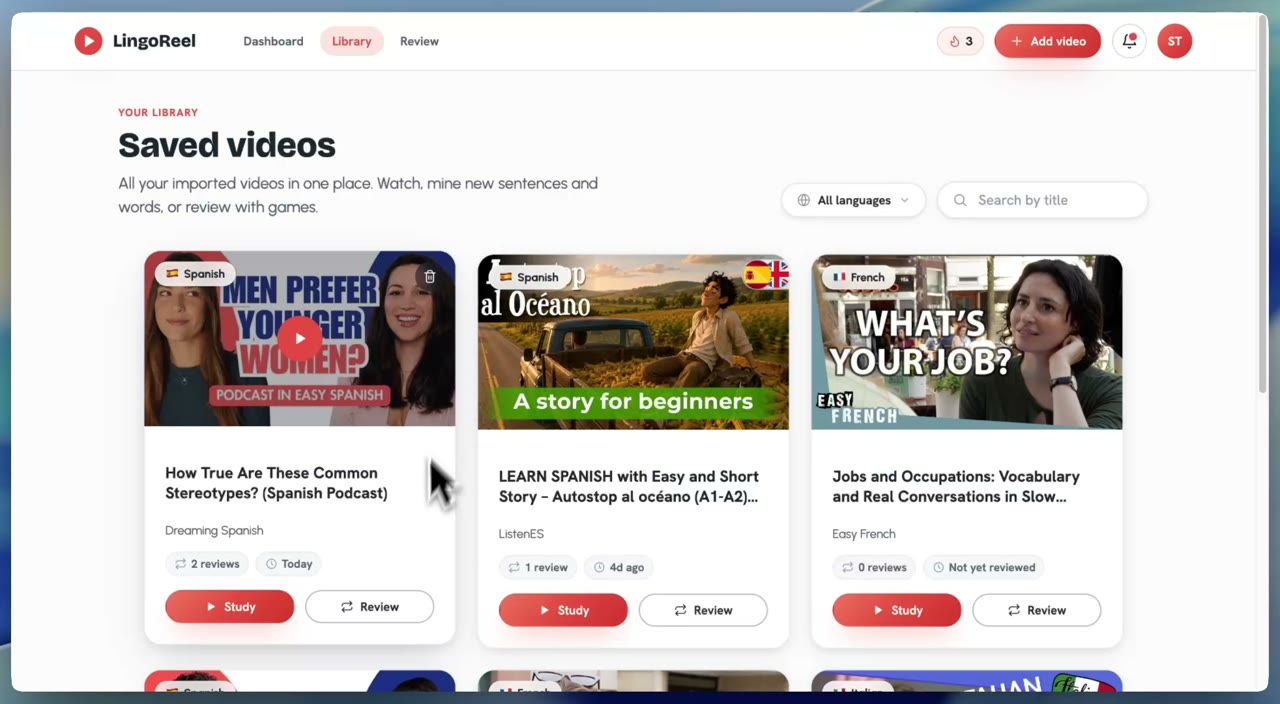
This is the gap Parlune was built to close: paste any French YouTube link and it transcribes the audio itself — not the caption track — into clean, accurate, audio-aligned French sentences you can tap word by word, even when the video has no captions at all. You listen to a line first, then reveal exactly what was said, turning any video you’d actually watch into a listen-then-reveal drill.
Don’t let a decoded clip evaporate
Cracking a clip once isn’t the same as owning it. French is especially harsh on review you do with your eyes only, because the written form of a word hides the two things you actually need — which letters go silent, and how it melts into its neighbours. A flashcard showing vous avez teaches you the spelling you already knew; it says nothing about the “voo-za-VAY” your ear has to catch in half a second.
So when you mine sentences from a video, hang on to the audio of that exact moment and review against it — catch the phrase by ear, take it down as dictation, reassemble the word order from sound. That’s how a liaison you puzzled out once turns into one you recognise at full speed: the jump from “I know that word” to “I caught that sentence.”
Fifteen minutes, done properly
Hours aren’t the point. A focused quarter-hour of French you actually follow will move you further than an evening of it murmuring in the background.
- Daily (15–20 min): an Alice Ayel or innerFrench video at your level, watched loosely for the gist — this is the stamina work.
- Two or three times a week (10 min): one short clip from a rung above you, run through the audio-first / reveal / re-listen passes until every join clicks into place.
- Weekly: pull three to five phrases you liked, with their audio, and come back to them by ear through the week — prioritising the ones where two words fused into one.
Pick real French, make it followable, capture phrases in context, drill them by ear — that’s the entire method, and it’s the one we apply to every language in how to learn a language with YouTube the right way.
Where to begin
The reason French resists your ear isn’t speed — it’s that it writes letters it won’t pronounce and then reshuffles the boundaries with liaison, a combination reading practice can’t prepare you for and passive hours won’t dissolve. What dissolves it is the climb: made-for-learners input, then semi-real content, then native video, each held at 70–80% understanding, with short audio-first work to expose the joins and by-ear review to lock in what you find.
So open one channel from your stage and start now. And the first time a native French video sits just out of reach — the one that turns to mush the moment you lean on the captions — bring it to Parlune: drop in the link, get an honest transcript of the real audio, and learn the words by hearing them. Subscription plans from $14.99/month, no ads. Liaison stops being a trap the moment you can see exactly where it lands.