The very first thing most people learn to say in Mandarin — 你好 — is quietly lying to you about how the language sounds. On paper both syllables are third tone: nǐ hǎo. But no native speaker actually says nǐ hǎo. Stack two third tones next to each other and the first one flips up into a rising second tone, so it comes out ní hǎo. That little shape-shift isn’t a special case; it’s happening all through natural Mandarin, which is why the tidy pinyin you drilled so often refuses to match the sound that lands in your ear.
There’s no shortage of real Mandarin to retrain that ear on — YouTube holds more of it than you could watch in a decade, from teachers stretching out every syllable to Taiwanese storytellers going flat out. Leaving it playing in the background, though, won’t rewire how you hear tones. What does is comprehensible input pointed straight at listening — material you can follow now, working up toward native speed — which is the same loop behind learning any language from YouTube. This page is the Mandarin-specific version of it: how the sounds actually work, the stages to climb, and real, named channels for each one.
Why Mandarin is harder to hear than to read
Most people who “know some Chinese” built that knowledge with their eyes — characters, an app, HSK vocab lists. Then a real conversation arrives as one fast, flat-sounding rush and none of it sticks. That isn’t a sign you’re behind. Mandarin is genuinely easier to read than to hear, for three concrete reasons, and reading practice does almost nothing for any of them.
The pitch is the word. In English, tone adds emotion on top of meaning; in Mandarin it is the meaning. The syllable ma is four different words depending on its pitch — 妈 (mā, mother), 麻 (má, hemp), 马 (mǎ, horse), 骂 (mà, scold) — plus a toneless 吗 (ma) that just turns a sentence into a question. Same consonant, same vowel; the melody carries everything. Your eyes never had to track that, so your ears never learned to.
The tone you memorised isn’t the tone you’ll hear. This is the part textbooks bury. Tones shift in connected speech — tone sandhi — and the rules bite on the most common words in the language. Two third tones in a row: the first becomes second (你好 → ní hǎo, 很好 → hén hǎo). 不 (bù, “not”) jumps to bú before a fourth tone (不是 → bú shì). 一 (yī, “one”) becomes yí before a fourth tone (一个 → yí gè) and yì before the others. So the pronunciation you carefully drilled in isolation mutates the instant the word is in a real sentence — and you only ever meet the mutated version by ear.
Characters are a crutch your ears don’t have. Mandarin runs on a small pool of syllables — only about 400 without tones, roughly 1,300 with them — so homophones are everywhere. Shì alone can be 是 (to be), 事 (matter), 市 (city), 试 (to try), 世 (world) and more. On the page the character tells you instantly which one it is. Spoken, you’ve got only the tone and the surrounding words to sort it out — and Mandarin is written with no spaces between words either, so nothing marks where one word ends and the next begins except your own knowledge of them.
The fix for all three is the same, and it isn’t another deck of flashcards: hear a lot of real Mandarin while an accurate transcript shows you the tones and the word boundaries, until your ear starts doing the sorting on its own.
Climbing in three stages (target: 70–80% understood)
“Watch Chinese YouTube” isn’t one activity — it’s three, and you graduate up through them as your ear catches up rather than jumping to the top and stalling:
- Made-for-learners input — a teacher speaking slowly, drawing and gesturing so you understand now, roughly 70–80% with no English. This is where acquisition genuinely starts.
- Semi-real content — street interviews and slow story channels: real voices and real pace, but short, on a topic you can follow, with subtitles to lean on.
- Native content made for natives — the vloggers and storytellers you’ll still be watching once you’re fluent. Over your head today; the aim is to drag them into reach now rather than parking them for a year away.
Wherever you are, aim to understand about 70–80%. Much below that and it’s just noise; much above and you’re revising, not learning. The moment a level feels easy, move up.
Stage 1 — Beginner: made to be understood
These creators speak slowly and show you what they mean, so you follow along from your first week. Begin here even if you’ve already ground through a few HSK lists.
- Lazy Chinese — Suqing tells simple stories entirely in Mandarin, with slow, crystal-clear enunciation, hand gestures and props doing the translating so you never need English. The most approachable on-ramp to real comprehensible input in Chinese.
- Comprehensible Chinese — Tingting, a trained teacher, uses the TPRS storytelling method: high repetition of useful phrases, lots of visual support, and clean natural pitch from the very first video, so your ear meets correct tones before bad habits set in.
- Blabla Chinese — story-based input carefully graded from absolute-zero (A0) upward, with separate super-beginner, beginner and intermediate tracks so you can sit exactly at your level and only nudge up when it’s comfortable.
Stay here until slow, clear Mandarin feels relaxed — usually the point where you can watch a super-beginner story straight through and follow it without stopping every line.
Stage 2 — Intermediate: real speakers, still followable
Now you want actual people, with just enough support that you’re not sunk. This is the stage where progress most often stalls, because learners either camp on beginner videos indefinitely or leap to full-speed vlogs and bail. These three are the bridge across.
- Mandarin Corner — unscripted street interviews with ordinary people, captioned in characters, pinyin and English, and tagged by HSK level. Real accents and real speed, but short and heavily supported — the ideal first dose of “how people actually talk.”
- Chinese with Redred — Redred walks around real Chinese cities narrating at a chosen HSK level, plus slow, comprehensible retellings of picture-book stories. Because she pins each video to a level, you can pick content that sits right at your edge.
- Grace Mandarin Chinese — Grace, a Taiwanese teacher, digs into pronunciation, slang and the differences between how the language is taught and how it’s spoken, covering both simplified and traditional characters. The best channel for understanding why fast Mandarin sounds nothing like your textbook.
The goal here isn’t to catch every word — it’s to hold the thread of what’s being said and let the unknown bits slide by. Once you can do that without strain, real native content is within reach.
Stage 3 — Advanced: made for Chinese people, not learners
This is what you’ll keep watching for life. It’s above your level today, and that’s exactly the point — worked in short pieces, it’s where your ear finally gets fast.
- 老高與小茉 Mr & Mrs Gao — a wildly popular Taiwanese duo who tell long, animated stories about mysteries, science and history. It’s dense, quick, unscripted Mandarin with real rhythm and sandhi live in every sentence — the closest thing to sitting in on a friend’s excited rant. If you can follow Lao Gao, you can follow most things.
- 李子柒 Liziqi — the famous rural-cooking and craft channel, stunning to watch. Be honest with yourself about it, though: it’s light on dialogue, so treat it as a calm way to pick up food, nature and tool vocabulary in context, not as dense listening practice.
- A native creator you’d watch in English anyway — a gaming stream, a make-up tutorial, a tech reviewer, a travel vlogger. Enjoyment is what buys you the hundreds of hours fluency actually costs, so pick the topic first and let your ear come along for the ride.
The trap at this stage is watching passively and calling it study. Native video only levels you up if you occasionally stop and decode — which is the next part.
The move that makes fast Mandarin usable now
You don’t have to wait to be “advanced” to study advanced content; you just work it in short pieces. Because meaning in Mandarin rides on pitch, the decoding step has a specifically Chinese shape:
- Play a short clip — ten to thirty seconds — with the text hidden. Just your ears. Try to catch the words and their tones. Replay it two or three times.
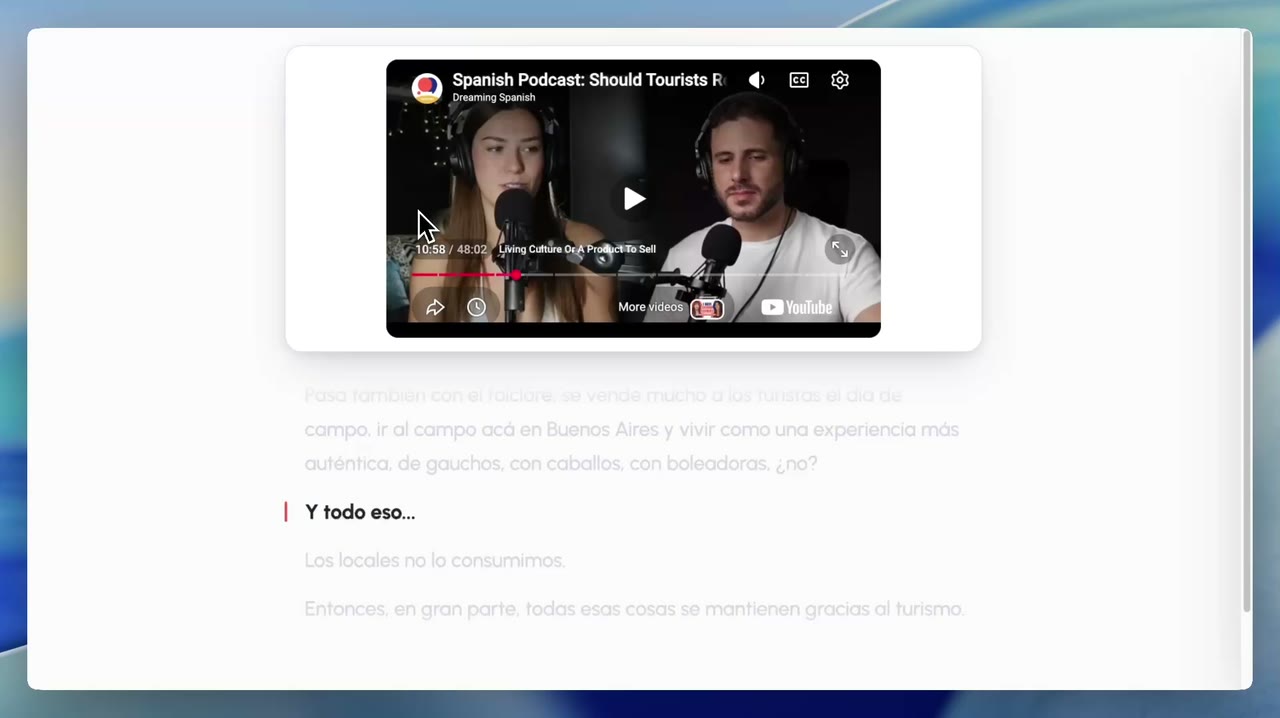
- Reveal the transcript and listen again. This is where it clicks: you see the word boundaries you’d blurred, and — the Mandarin-specific payoff — you spot the tones you misheard and the sandhi you didn’t expect (that nǐ hǎo that was really ní hǎo all along).
- Hide the text and play it one more time. Now that your brain knows what’s there, you’ll actually hear it. That re-hearing is the rep that sticks.
That “oh, that’s what they said” jolt is the real engine of listening improvement — there’s a fuller walkthrough in training your ear so native speech stops sounding like one long word.
The friction has always been getting an accurate transcript in the first place. Most Mandarin videos have no captions, and YouTube’s auto-captions mangle exactly what trips you up — they routinely pick the wrong homophone, flatten tones and guess word boundaries wrong — so a caption-based tool inherits garbled Chinese and, worse, keeps the text on screen the whole time, which means you can never listen blind first. This is the gap Parlune was built to close: paste any YouTube link and it transcribes the audio itself, not the caption track, into clean, audio-aligned Mandarin sentences you can tap character by character — accurate even when the video has no captions at all. You listen to a line, then reveal the exact words, turning anything you’d genuinely watch into a blind-then-reveal drill. (We compare the whole category honestly in the best tools for learning a language from YouTube, and cover where caption-first tools run out of road in our Language Reactor alternative piece.)
Review by ear, because a character on a card hides the sound
The last piece is what happens after you decode a line. Mandarin punishes eye-only review harder than most languages: recognising 谢谢 on a flashcard proves nothing about its tones or how it sounds crushed into fast speech. Save a word as its written form alone and you’ve quietly dropped the hardest half of the work — the half that was the whole reason you struggled.
So when you mine sentences from a video, keep the audio of the exact moment and review on that clip: catch the word by ear, take dictation, reorder what you hear. That’s how a word you decoded once becomes a word you’ll actually recognise the next time it flies past at full speed — the difference between “I know that character” and “I understood the sentence.”
A weekly rhythm that works
- Daily (15–20 min): one beginner or made-for-learners video as easy, gist-level listening — this is the stamina base, and it should feel almost effortless.
- A few times a week (10 min): one short clip from a notch above your level, worked with the listen-then-reveal drill until you can hear every word and its tone.
- Weekly: mine three to five lines you liked, with their audio, and review them by ear over the following days, checking the tone of every syllable you replay.
Consistency is what compounds here, not marathon sessions. A quarter-hour of Mandarin you actually understand and work will move your ear further than an afternoon of audio washing past unexamined.
Where to start
Mandarin’s reputation for being brutally hard is really a reputation for being hard to hear — the tones, the sandhi, the homophones that characters quietly resolve on the page and your ears have to resolve in real time. Reading drills won’t fix that, and neither will passive hours you don’t decode. What fixes it is the ladder above — made-for-learners input, then semi-real content, then native video — climbed at 70–80% understanding, with short listen-then-reveal reps to un-blur real speech and audio-based review so the gains hold.
Open a Stage 1 channel and watch one video today. Then take something a rung too fast — the funny, dense, genuinely interesting one — and work thirty seconds of it with Parlune: paste the link, get an accurate transcript built from the audio, and check your ear against the tones one line at a time. Subscription plans from $14.99/month. The sandhi is already in the recording; this is how you start hearing it.