The polite です drilled into you in every textbook barely keeps its vowel when a native says it — it lands closer to “dess,” the u swallowed whole. 好き (“like”) comes out “ski.” Chain a few words together and the Japanese you can comfortably read on the page collapses into a single unbroken rush of sound the moment someone speaks it. That distance between reading Japanese and hearing it is the real wall, and it’s an ear problem, not a vocabulary one.
There is no shortage of material to knock that wall down — YouTube holds more real Japanese than you could watch in ten lifetimes, from teachers who slow every syllable down to game streamers going a mile a minute, plus cooking channels, news and variety TV. But letting it wash over you passively won’t retrain your ear. What works is comprehensible input pointed straight at listening — followable material now, climbing from beginner-slow up to native speed — the same loop behind learning any language from YouTube.
This is that method, built specifically around how Japanese sounds and reads, with the exact channels worth your time at each level. Every channel here is real and named so you can go press play the moment you finish reading.
Why Japanese is hard to catch by ear (even after you’ve studied it)
Most people who “know some Japanese” learned it with their eyes — Duolingo, an app, a textbook, kanji flashcards. Then they hear it and it dissolves into one smooth, fast stream. That isn’t you being slow. Japanese has three specific features that make listening a genuinely separate skill from reading it.
1. Written Japanese has no spaces. A sentence is an unbroken run of hiragana, katakana and kanji: 「にほんごはむずかしいですか」 (Nihongo wa muzukashii desu ka? — “Is Japanese difficult?”). Nothing on the page tells you where one word stops and the next starts. You do that segmentation from knowing the words, which means when you hear the sentence spoken, your ear has to find the word boundaries in real time with no visual help at all. This is the same problem CJK learners hit that Spanish or French learners don’t — and it’s exactly why an accurate, tappable transcript matters so much.
2. Pitch, not stress, carries meaning. English words have a stressed syllable you can lean on. Japanese words are distinguished by pitch — whether the voice steps up or down across the moras. The classic example: 箸 (hashi, “chopsticks”, high→low) and 橋 (hashi, “bridge”, low→high) are the same sounds in a different pitch shape. Textbooks almost never mark this, so the only way to internalise it is to hear a lot of real speech — not read it.
3. Casual speech drops half of what you studied. Textbook Japanese is polite: 「これを食べますか?」 (“Will you eat this?”). Real speech shears it down to 「これ、食べる?」 — particle gone, polite ending gone, tone doing the work. Add sentence-final particles (ね, よ, な, さ) that carry mood but no dictionary meaning, and the gap between the tidy Japanese you learned and the Japanese people actually say gets wide fast.
The fix for all three is the same: hear a lot of real Japanese while you can see an accurate transcript, so your eyes teach your ears where the words are and what pitch they ride on. That’s the whole game — it’s the core idea behind comprehensible input, aimed squarely at your ear.
The method: climb the ladder, don’t jump it
The mistake is treating “watch Japanese YouTube” as one activity. It’s really three stages, and you graduate through them rather than skipping to the top.
- Made-for-learners comprehensible input — a teacher speaking slowly, drawing pictures and using gestures so you understand now, around 70–80% without translation. This is where acquisition actually starts.
- Semi-real content — street interviews and slow story channels: real voices and real speed, but short, on a followable topic, with subtitles.
- Native content made for natives — the vloggers, gamers and podcasts you’ll still be watching when you’re fluent. Above your level today; the goal is to pull them into reach now instead of waiting a year.
Aim for 70–80% understanding at whatever stage you’re in. Below that it’s noise and nothing sticks; well above it you’re not learning anything new. When a level starts to feel easy, climb.
Stage 1 — Beginner: channels built to be understood
These creators speak slowly and visually so you follow along from day one. Start here even if you’ve “done some Japanese.”
- Comprehensible Japanese — the reference point for the whole comprehensible-input method in Japanese. Yuki speaks entirely in Japanese but draws, points and repeats so you understand with zero English, and everything is graded from Complete Beginner upward. If you watch one channel, watch this one — it trains your ear on natural pitch and rhythm from the start.
- Japanese Ammo with Misa — Misa explains grammar and everyday phrases clearly in English, with real, natural example sentences. The best “why does Japanese do that?” channel for when a grammar point (particles, て-form, casual vs polite) won’t click.
- Nihongo con Teppei (Beginner) — a short daily podcast, all on YouTube, entirely in simple Japanese. Teppei is uncannily good at sensing where a beginner will get lost and rephrasing in easier words. Five-minute episodes make it the easiest listening habit to actually keep.
Stay here until slow, clear Japanese feels comfortable — usually when you can follow a Comprehensible Japanese beginner video without pausing every line.
Stage 2 — Intermediate: real voices, real speed, still followable
Now you want real people, but with enough support that you’re not lost. This is where most learners stall — they either camp on beginner content forever or leap straight to native variety shows and bounce. These channels are the bridge.
- Miku Real Japanese — Miku breaks down real, natural Japanese (JLPT N4–N3 territory), including the slang and contractions textbooks skip. Her street-interview and casual-chat videos are perfect for getting your ear onto the rhythm and tone of how people actually speak.
- Easy Japanese — unscripted street interviews with triple subtitles (Japanese, rōmaji, English). Real accents, real filler, real speed, but short and captioned — the ideal first taste of “actual people talking” without drowning.
- YUYUの日本語 Podcast — two friends chatting about everyday topics in natural but intermediate-friendly Japanese. Longer than Teppei, more real than a lesson: great for building listening stamina on genuine conversation.
The goal at this stage isn’t every word — it’s following the gist and letting the unknowns wash past. When you can do that comfortably, you’re ready for the real thing.
Stage 3 — Advanced: native content made for natives
This is the payoff — Japanese made for Japanese people, at full speed, with the pitch, slang and sentence-final particles all live. You won’t catch everything, and that’s fine. The move is to take short pieces of it and work them until you can.
- That Japanese Man Yuta — real street interviews with ordinary Japanese people about culture, opinions and daily life. Natural speech, but subtitled and topic-driven, so it’s the gentlest on-ramp from “learner content” to “native content.”
- Native creators you’d watch anyway — a cooking channel, a game streamer, a travel vlogger, a comedy duo. Pick something you’d genuinely enjoy in English and find its Japanese equivalent. Enjoyment is what gets you the hundreds of hours that fluency actually requires.
The trap here is passive watching. Native content only levels you up if you occasionally stop and decode — which is the next section.
The technique that makes hard videos usable now: listen blind, then reveal
You don’t have to wait until you’re “advanced” to use advanced content. You just have to work it in short pieces. The single most effective drill costs a few minutes:
- Listen to a short clip — ten to thirty seconds — with no text. Just your ears. Try to catch every word. Replay it two or three times.
- Now reveal the transcript and listen again while reading. This is the moment your eyes show you exactly where the word boundaries were and which sounds you’d merged — and you feel the click as a blur resolves into 「これ、食べる?」.
- Hide the text and listen once more. Now that your brain knows what’s there, you’ll hear it. That re-hearing is the rep that sticks.
That click — hearing the gap you were missing, then hearing it correctly — is the actual mechanism of listening improvement. There’s a full walkthrough in our guide to training your ear so native speech stops sounding like one long word.
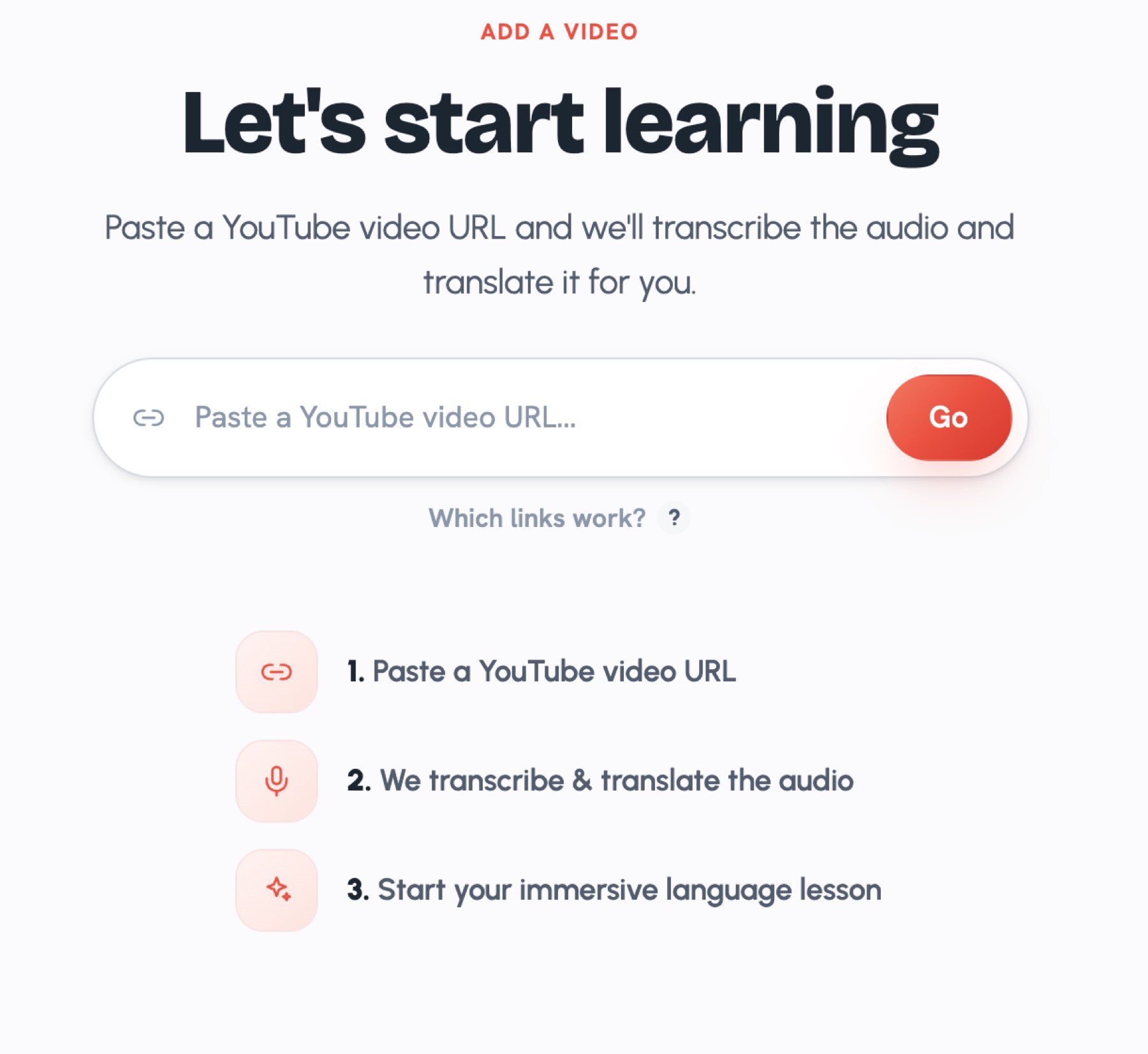
The friction has always been the transcript. Most Japanese YouTube videos have no captions, or auto-captions that mangle spaceless Japanese and homophones badly enough to teach you the wrong reading — and the caption sits on screen the whole time, so you can never listen blind first. This is exactly the gap Parlune was built to close: paste any YouTube link and it transcribes the audio itself into clean, audio-aligned Japanese sentences you can tap word by word, so the text is accurate even when the video has none. You listen to a line first, then reveal the exact words — turning any video you’d actually watch into a blind-then-reveal drill.
What survives the week, and what quietly does not
The last piece is what happens after you decode a clip. Japanese punishes eye-only review harder than most languages, because a kanji you can recognise on a flashcard tells you nothing about its pitch or how it sounds crushed into fast speech. If you save a new word to a card that only shows the written form, you’ve dropped the hardest half of the work.
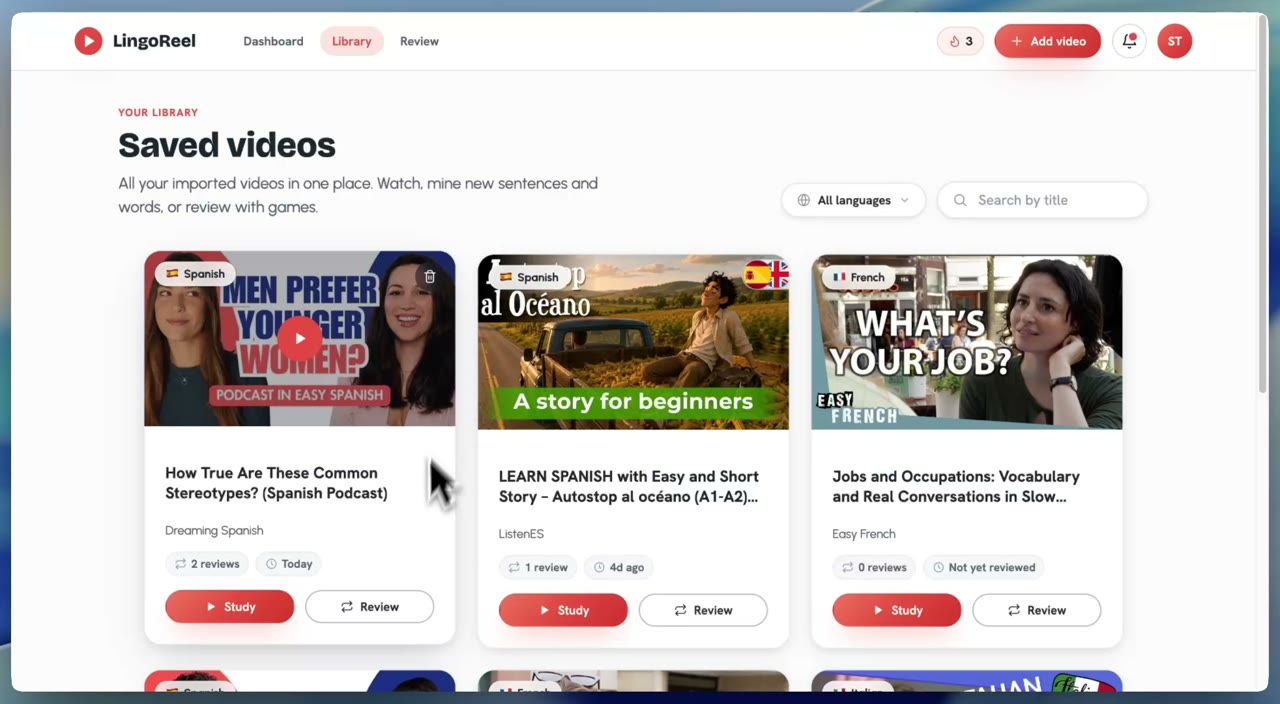
So when you mine sentences from a video, keep the audio of the exact moment, and review on that clip: catch the word by ear, take dictation, reorder what you hear. That’s how a word you decoded once becomes a word you’ll actually catch next time it flies past — and it’s the difference between “I know this kanji” and “I understood the sentence.”
A realistic weekly routine
- Daily (15–20 min): one Comprehensible Japanese or Teppei episode as extensive listening — relaxed, gist-level, building stamina.
- A few times a week (10 min): one short clip from a level above yours, worked with the blind-then-reveal drill until you can hear every word.
- Weekly: mine three to five sentences you liked, with their audio, and review them by ear across the week.
That’s it. Fifteen honest minutes of the right kind of listening beats an hour of background noise you don’t actively work.
The honest summary
Japanese is hard to catch by ear because it’s written without spaces, distinguished by pitch rather than stress, and spoken far more loosely than any textbook admits. Reading practice won’t fix that, and neither will passive hours of audio you don’t decode. What fixes it is a ladder — made-for-learners input, then semi-real content, then native video — climbed at 70–80% understanding, with short-clip blind-then-reveal listening to un-blur real speech and audio-based review so the gains stick.
If you want a fuller picture of the underlying approach, see our pillar on how to learn a language with YouTube the right way, or the honest roundup of tools for learning from YouTube if you’re comparing options.
And if you want to try the blind-then-reveal drill on Japanese videos you’d actually watch, see how Parlune works — subscription plans from $14.99/month, no ads, no free-caption fudging. Paste a Japanese video, listen before you look, and see how much more you catch once your ear knows what’s there.